Alioramus (/ˌælioʊˈreɪməs/; meaning 'different branch') is a genus of tyrannosauridtheropod dinosaurs from the Late Cretaceousperiod of Asia. It currently contains two species. The type species, A. remotus is known from a partial skull and three foot bonesrecovered from the Mongolian Nemegt Formation, which was deposited in a humid floodplain about 70 million years ago. These remains were named and described by Sovietpaleontologist Sergei Kurzanov in 1976. A second species, A. altai, known from a much more complete skeleton, was named and described by Stephen L. Brusatte and colleagues in 2009. Its relationships to other tyrannosaurid genera are unclear, with some evidence supporting a hypothesis that Alioramus is closely related to the contemporary species Tarbosaurus bataar.
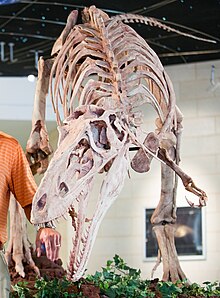

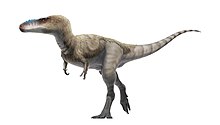
Alioramus were bipedal like all known theropods, and their sharp teeth indicate that they were carnivores. Known specimens were smaller than other tyrannosaurids like Tarbosaurus bataar and Tyrannosaurus rex, but their adult size is difficult to estimate since both Alioramus species are known only from juvenile or sub-adult remains. The recent discovery of Qianzhousaurus indicates that it belongs to a distinct branch of tyrannosaur.[2]The genus Alioramus is characterized by a row of five bony crests along the top of the snout, a greater number of teeth than any other genus of tyrannosaurid, and a lower skull than most other tyrannosaurids.
History of discovery
The holotype (PIN 3141/1) of Alioramus is a partial skull associated with three metatarsals. A joint Soviet-Mongolian expedition to the Gobi Desert in the early 1970s found these remains at a locality known as Nogon-Tsav in the Mongolian province of Bayankhongor, Nemegt Formation. Alioramuswas named and described by Russianpaleontologist Sergei Kurzanov in 1976. Its crests and low skull profile looked so different from other tyrannosaurids that Kurzanov believed his find was far removed from other members of the family. Accordingly, he gave it the generic name Alioramus, derived from the Latin alius('other') and ramus ('branch'), and the specific name A. remotus, which means 'removed' in Latin.[3] A second species, A. altai, was discovered back in 2001 at the Tsagan Khushu locality also from the Nemegt Formation. However, several faunal differences may suggest that the respective locations of A. remotus and A. altai differ in age. The holotype IGM 100/1844 is a partial skeleton that includes a very complete skull—more so than A. remotus—with partial vertebrae, pelvic girdle and hindlimbs. The name for this species, altai, is in reference to the Altai Mountains.[4]
Description


Alioramus remotus was estimated at 5 to 6 m (16 to 20 ft) in length when originally described by Sergei Kurzanov in 1976.[3] In 1988 Paul gave a similar length of 6 m (20 ft) and a weight of 700 kg (1,500 lb).[5] In 2016 Molina-Pérez and Larramendi estimated A. remotus at 5.5 m (18 ft) and 500 kg (1,100 lb), and A. altai at 5 m (16 ft) and 385 kg (849 lb).[6] Kurzanov, however, did not correct for lengthening of the skull by deformation during fossilization, which may indicate a shorter overall body length for this individual. If this specimen is a juvenile, then adult Alioramus would have reached greater lengths, but no confirmed adult specimens are known.[7]
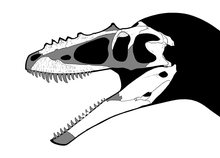
The skull of A. remotus was approximately 45 cm (1.48 ft) long.[8] In general, it is long and low, a shape typical of more basaltyrannosauroids and juveniles of larger tyrannosaurids. The premaxillary bones at the tip of the snout in Alioramus remotus have not been found, but are taller than wide in all tyrannosauroids for which they are known.[7]The nasal bones are fused and ornamented with a row of five irregular bony crests that protrude upwards from the midline, where the nasal bones are sutured together. These crests all measure more than 1 cm (0.39 in) tall.[3]
At the back of the skull there is a protrusion, called the nuchal crest, arising from the fused parietal bones, a feature shared with all tyrannosaurids. In Alioramus, the nuchal crest is greatly thickened, similarly to Tarbosaurusand Tyrannosaurus. Like the rest of the skull, the lower jaw of Alioramus was long and slender, another possible juvenile characteristic.[7] As in Tarbosaurus, a ridge on the outer surface of the angular bone of the lower jaw articulated with the rear of the dentary bone, locking the two bones together and removing much of the flexibility seen in other tyrannosaurids.[9] Other tyrannosaurids had four premaxillary teeth, D-shaped in cross section, on each side. Including 16 or 17 in each maxilla, and 18 in each dentary, Alioramus had 76 or 78 teeth, more than any other tyrannosaurid.[10] The braincase of A. altai was intermediate between the basal theropod and avialan conditions.[11]
The rest of the skeleton of Alioramus remotusis completely unknown except for three metatarsals (bones of the upper foot), but the discovery of A. altai, which is known from substantially more complete remains, has shed light on the anatomy of the genus.[4]
Classification and systematics
Paleontologists have long classifiedAlioramus within the superfamilyTyrannosauroidea, but because its remains were for many years poorly known, a more precise classification had remained elusive until the discovery of A. altai.[7] A cladisticanalysis published in 2003 found Alioramuscould be further classified into the family Tyrannosauridae and the subfamilyTyrannosaurinae, alongside Tyrannosaurus, Tarbosaurus and Daspletosaurus.[12] A 2004 study supported this result but suggested it was equally probable that Alioramusbelonged outside the family Tyrannosauridae entirely, with its supposed juvenile characters actually reflecting a more basal position within Tyrannosauroidea.[7] Another study omitted Alioramus altogether due to the only specimen's fragmentary nature.[13] The description of A. altai in 2009 confirmed the placement of the genus within the Tyrannosaurinae.[4]

Tarbosaurus and Alioramus shared several skull features, including a locking mechanism in the lower jaw between the dentary and angular bones, and both lacked the prong of the nasal bones which connected to the lacrimal bones in all other tyrannosaurids except adult Daspletosaurus. The two genera may be closely related, representing an Asian branch of the Tyrannosauridae.[9][12] Some specimens of Tarbosaurus have a row of bumps on the nasal bones like those of Alioramus, although much lower. The long and low shape of the only known Alioramus remotus skull indicated that it was immature when it died and might even have been a juvenile Tarbosaurus, which lived in the same time and place. The more prominent nasal crests and much higher tooth count of Alioramus, however, suggested it was a separate taxon, even if it is known only from juvenile remains,[10] confirmed by the discovery of A. altai.[4] Specimens identified as immature Tarbosaurus have the same tooth count as adults.[14][15]
Recently a cladogram has been published finding Alioramus just outside Tyrannosauridae. Below is the cladogram by Loewen (2013).[16]


Paleoecology

The Beds of Nogon-Tsav are considered to be the same age as the Nemegt Formation.[3]This geologic formation has never been dated radiometrically, but the fauna present in the fossil record indicate it was probably deposited during the Maastrichtian stage, at the end of the Late Cretaceous.[17]
The Maastrichtian stage in Mongolia, as preserved in the Nemegt Formation and at Nogon-Tsav, was characterized by a wetter and more humid climate compared with the semi-arid environment preserved in the earlier, underlying Barun Goyot and Djadochta Formations. Nemegt sediments preserve floodplains, large river channels and soil deposits, but caliche deposits indicate periodic droughts.[18] This environment supported a more diverse and generally larger dinosaur fauna than in earlier times. Kurzanov reported that other theropods, including Tarbosaurus, ornithomimosaurs and therizinosaurs were discovered at the same locality,[3] but these remains have never been reported in detail. If the Nogon Tsav faunawas similar to that of the Nemegt Formation, troodontid theropods, as well as pachycephalosaurs, ankylosaurids and hadrosaurs would also have been present.[17]Titanosaurian sauropods were also potential prey for predators in the Nemegt.[9]
| This article uses material from the Wikipedia article Metasyntactic variable, which is released under the Creative Commons Attribution-ShareAlike 3.0 Unported License. |