Barsboldia (meaning "of Barsbold", a well-known Mongolian paleontologist) was a genusof large hadrosaurid dinosaur from the early Maastrichtian Nemegt Formation of Ömnogöv', Mongolia. It is known from a partial vertebral column, partial pelvis, and some ribs.


Description
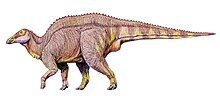
Teresa Maryańska and Halszka Osmólskabased this genus on holotype ZPAL MgD-1/110, a partial skeleton consisting of nine back vertebrae, nine hip vertebrae, fifteen tail vertebrae, a left ilium, parts of the left and right pubis, several ribs, and a few fragments of the hind limbs, with the backbone largely articulated. The most distinctive features of this skeleton are found in the neural spines. These are very tall, particularly over the hips, and were described as second only to those of Hypacrosaurus altispinus and the tips of those found in the first few vertebrae of the tail are club-shaped[1] (possibly a sign of old age).[2] In 2010 Gregory S. Paul gave a length of 10 meters (33 ft) and a weight of 5 tonnes (5.5 short tons).[3]
Phylogeny
Maryańska and Osmólska described their new genus as a lambeosaurine (or hollow-crested duckbill), the first from the Nemegt Formation, although it lacked a skull. However, the sacrum has a keel along the bottom, a possible lambeosaurine feature,[4]and the bones closely resemble those of Hypacrosaurus.[2][5] With only one partial skeleton known, and no skull, the genus has been considered dubious[4] or a possible lambeosaurine of uncertain placement.[6] A newer study published in 2011 suggests that Barsboldia is actually a valid saurolophine.[7]
The following cladogram was recovered in the 2011 phylogenetic analysis of Hadrosauroideaby Prieto-Márquez (the relationships within Lambeosaurinae and between basal hadrosauroids aren't shown).[7]


Paleobiology
As a hadrosaurid, Barsboldia would have been a bipedal/quadrupedal herbivore, eating plants with a sophisticated skull that permitted a grinding motion analogous to chewing, and was furnished with hundreds of continually-replaced teeth. If it was a lambeosaurine, it would have had a hollow crest formed out of expanded skull bones containing the nasal passages, with a function relating to identification by sight and sound.[6]
| This article uses material from the Wikipedia article Metasyntactic variable, which is released under the Creative Commons Attribution-ShareAlike 3.0 Unported License. |