Blasisaurus is a genus of lambeosaurinehadrosaurid dinosaur from the Late Cretaceous. It is known from a partial skull and skeleton found in late Maastrichtian-age rocks of Spain.[1] The type species is Blasisaurus canudoi, described in 2010 by Penélope Cruzado-Caballero, Xabier Pereda-Suberbiola and José Ignacio Ruiz-Omeñaca, a group of researchers from Spain.

Naming and discovery
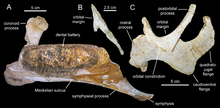
The generic name refers to the Blasi 1 site where the fossil was found. The specific epithet honours paleontologist José Ignacio Canudo.[1] The holotype, MPZ99/667, is housed in Huesca. It was found in a layer of the Arén Formation dating from the upper Maastrichtian, about 66 million years old.[1] It consists of a skull with fragmentary lower jaws.[1]
Description
Blasisaurus is a medium-sized euornithopod. The describers have been able to identify two distinct features: the cheekbone has a rear projection with a hook-shaped upper edge, and the lower sleep window is narrow and D-shaped.[1] From the same formation is Arenysaurus, a related species. They are not identical, distinguished by the shape of the teeth and missing secondary ridges. Blasisaurus also differs from Koutalisaurusby a downwardly bent front edge of the lower jaws.[1]
Phylogeny
The describers performed an exact cladistic analysis to determine its phylogenetic position. The outcome of the phylogenetic analysis placed Blasisaurus as the sister taxon to Arenysaurus.[1] Together they form a clade that is higher in Lambeosaurinae than Tsintaosaurus and Jaxartosaurus. Whether this clade was more derived than Amurosaurus, the closest relative of the group, was not determined.[1] However, one study did find that they were not sister taxa, no other studies supported this.[2]Blasisaurus confirmed the hypothesis that in the Late Cretaceous, different Hadrosauridsfrom Asia and Europe was a sign that they migrated across land bridges that must have been present.[1] Where in lambeosaurinae Blasisaurus and Arenysaurus fall is disputed. They have been found to be in lambeosaurini,[3] as basal to the Lambeosaurini-Parasaurolophini split,[1] and in Parasaurolophini.[2][4] Below is the most recent cladogram published including Blasisaurus and Arenysaurus, found by Penélope Cruzado-Caballero et al. in 2013:[4]