Carcharodontosaurus/ˌkɑːrkəroʊˌdɒntoʊˈsɔːrəs/ is a genus of large carcharodontosaurid theropod dinosaur that existed during the Cenomanian stage of the mid-Cretaceous Period in Northern Africa. It is currently known to include two species: C. saharicus and C. iguidensis, which are among the largest theropods, nearly as large as or even larger than Tyrannosaurus, Giganotosaurus, and Spinosaurus.
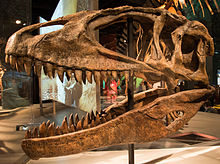

The genus Carcharodontosaurus is named after the shark genus Carcharodon,[1] itself composed of the Greek karchar[os](κάρχαρος, meaning "jagged" or "sharp") and odōn (ὀδών, "teeth"), and the suffix -saurus("lizard").
History of discovery


In 1924, two teeth were found in the Continental intercalaire of Algeria, showing what were at the time unique characteristics. These teeth were described by Depéret and Savornin (1925) as representing a new taxon, which they named Megalosaurus saharicus[2]and later categorized in the subgenusDryptosaurus.[3] Some years later, paleontologist Ernst Stromer described the remains of a partial skull and skeleton from Cenomanian aged rocks in the Bahariya Formation of Egypt (Stromer, 1931);[1]originally excavated in 1914, the remains consisted of a partial skull, teeth, vertebrae, claw bones and assorted hip and leg bones.[1]The teeth in this new finding matched the characteristics of those described by Depéret and Savornin, which led to Stromer conserving the species name saharicus but finding it necessary to erect a new genus for this species, Carcharodontosaurus, for their strong resemblance to the teeth of Carcharodon (Great white shark).[1]
The fossils described by Stromer were destroyed in 1944 during World War II, but a new, more complete skull was found in the Kem Kem Formation of Morocco during an expedition led by paleontologist Paul Serenoin 1995, near the Algerian border and the locality where the teeth described by Depéret and Savornin (1925) were found. The teeth found with this new skull matched those described by Depéret and Savornin (1925) and Stromer (1931); the rest of the skull also matched that described by Stromer. This new skull was designated as the neotype by Brusatte and Sereno (2007) who also described a second species of Carcharodontosaurus, C. iguidensis from the Echkar Formation of Niger, differing from C. saharicus in aspects of the maxilla and braincase.[4]
The taxonomy of Carcharodontosaurus was discussed in Chiarenza and Cau (2016), who noted that the neotype of C. saharicus was similar but distinct from the holotype, which is problematic because the holotype of C. saharicus is more closely related to the holotype of C iguidensis than the neotype, SGM-Din 1. The authors also identified the referred material of C. iguidensis as belonging to Sigilmassasaurus and a non-carcharodontosaurine, and therefore chose to limit C. iguidensis to the holotype pending future research.[5]
Description
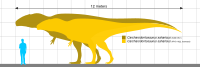
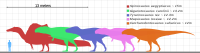
Carcharodontosaurus includes some of the longest and heaviest known carnivorous dinosaurs, with various scientists proposing length estimates for the species C. saharicusranging between 12 and 13.3 meters (39 and 44 ft) and weight estimates between 6.2 to 15.1 metric tons (6.8 to 16.6 short tons).[6][7][8][9] In 2016 Molina-Pérez & Larramendi gave a length of 12.8 meters (42 ft) and a weight of 7.8 metric tons (8.6 short tons) for the neotype of C. saharicus, and a length of 11 meters (36 ft) and a weight of 5.2 metric tons (5.7 short tons) for a referred tooth of C. iguidensis.[10]
Carcharodontosaurus were carnivores, with enormous jaws and long, serrated teeth up to eight inches long. A skull length of about 1.42–1.6 m (4.7–5.2 ft) has been restored for the neotype of C. saharicus.[11][7] Currently, the largest-known theropod skull belongs to another huge carcharodontosaurid dinosaur, the closely related Giganotosaurus (with skull length estimates up to 1.95 m (6.4 ft))[12] but this has been disputed.[11] Gregory S. Paul estimates Carcharodontosaurus iguidensis at 10 meters (33 ft) and 4 metric tons (4.4 short tons).[13]
Brain and inner ear

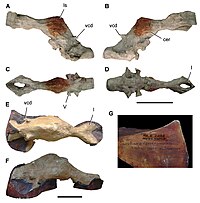
In 2001, Hans C. E. Larsson published a description of the inner ear and endocraniumof Carcharodontosaurus saharicus.[14]Starting from the portion of the brain closest to the tip of the animal's snout is the forebrain, which is followed by the midbrain. The midbrain is angled downwards at a 45-degree angle and towards the rear of the animal. This is followed by the hindbrain, which is roughly parallel to the forebrain and forms a roughly 40-degree angle with the midbrain.[14] Overall, the brain of C. saharicuswould have been similar to that of a related dinosaur, Allosaurus fragilis.[14] Larsson found that the ratio of the cerebrum to the volume of the brain overall in Carcharodontosaurus was typical for a non-avian reptile.[14] Carcharodontosaurus also had a large optic nerve.[14]
The three semicircular canals of the inner earof Carcharodontosaurus saharicus – when viewed from the side – had a subtriangular outline.[14] This subtriangular inner ear configuration is present in Allosaurus, lizards, turtles, but not in birds.[14] The semi-"circular" canals themselves were actually very linear, which explains the pointed silhouette.[14] In life, the floccular lobe of the brain would have projected into the area surrounded by the semicircular canals, just like in other non-avian theropods, birds, and pterosaurs.[14]
Classification




The following cladogram after Apesteguía et al., 2016, shows the placement of Carcharodontosaurus within Carcharodontosauridae.[15]

Paleobiology

Feeding
A study by Donald Henderson, the curator of dinosaurs at the Royal Tyrrell Museumsuggests that Carcharodontosaurus was able to lift animals weighing a maximum of 424 kg (935 lb) in its jaws based on the strength of its jaws, neck, and its center of mass.[16]
Pathology
SGM-Din 1, a Carcharodontosaurus saharicusskull, has a circular puncture wound in the nasal and "an abnormal projection of bone on the antorbital rim".[17]
| This article uses material from the Wikipedia article Metasyntactic variable, which is released under the Creative Commons Attribution-ShareAlike 3.0 Unported License. |