Dyoplosaurus (meaning "double-armored lizard") is an extinct genus of ankylosauriddinosaurs within the subfamily Ankylosaurinae. It is known from the lower levels of the Late Cretaceous Dinosaur Park Formation (latest middle Campanian stage, about 76.5 Ma ago) of Alberta, Canada. It contains a single species, Dyoplosaurus acutosquameus.[1]

History of discovery
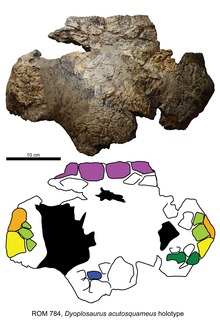
Dyoplosaurus was named by William Parks in 1924, based on holotype ROM 784, a partial skeleton including parts of the skull and lower jaws. It was collected from the bottom 10 m of the Dinosaur Park Formation, near what is now the Red Deer River in Alberta, Canada.
Description

The type specimen of Dyoplosaurus was about 4–4.5 m (13–15 ft) long[2] and about 5.8 feet (1.7 m) wide, with a skull measuring 14 inches (35 centimeters) across. Like most other ankylosaurids, it was quadrupedal, ground-dwelling and herbivorous, with an armored body and a bony club on the end of its tail. The club was composed of several armor plates fused together.[3] The tail club possessed by Dyoplosaurus is relatively small and narrow, when compared to that of other ankylosaurids.
Classification

In 1971, Walter Coombs proposed that Dyoplosaurus was a junior synonym of Euoplocephalus. The two were since generally assumed to be the same species and thus, former Dyoplosaurus specimens have been identified as Euoplocephalus tutus. However, a redescription of the genus published in 2009 in the Journal of Vertebrate Paleontologyclaims that the genus is a valid taxon, suggesting that the proposed synonymy was due to the fragmentary nature of the holotype and other specimens of E. tutus.[1] The cladistic analysis performed by Thompson et al., 2011 confirmed this separation.[4] The following cladogram is based on a 2015 phylogenetic analysis of the Ankylosaurinae conducted by Arbour and Currie:[5]
This article uses material from the Wikipedia article
Metasyntactic variable, which is released under the
Creative Commons
Attribution-ShareAlike 3.0 Unported License.
Metasyntactic variable, which is released under the
Creative Commons
Attribution-ShareAlike 3.0 Unported License.