Hypselospinus is a genus of iguanodontiandinosaur which was first described as a species of Iguanodon (I. fittoni) by Richard Lydekker in 1889, the specific name honouring William Henry Fitton.[1]
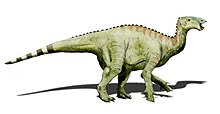

In May 2010 the fossils comprising Hypselospinus were by David Normanreclassified as a separate genus, among them the holotype BMNH R1635, consisting of a left ilium, a sacrum, tail vertebrae and teeth. The generic name is derived from Greek hypselos, "high" and Latin spina, "thorn", in reference to the high vertebral spines. Later that same year, a second group of scientists independently re-classified I. fittoni into a new genus they named Wadhurstia,[2] which thus is a junior objective synonym of Hypselospinus. Hypselospinus lived during the lower Valanginian stage, around 140 million years ago.[2][3] A contemporary of Barilium(also once thought to be a species of Iguanodon), Hypselospinus was a lightly built iguanodontian estimated at 6 metres (19.7 ft) long.[4] The species Iguanodon fittoni was described from the lower Valanginian-age Lower Cretaceous Wadhurst Clay[2] of East Sussex, England.[5] Remains from Spain may also pertain to it. Norman (2004) wrote that three partial skeletons are known for it,[5] but this is an error.[6]
Hypselospinus is separated from Barilium on the basis of vertebral and pelvic characters, size, and build.[4] For example, Barilium was more robust than Hypselospinus, with large Camptosaurus-like vertebrae featuring short neural spines, whereas Hypselospinus is known for its "long, narrow, and steeply inclined neural spines".[5]
| This article uses material from the Wikipedia article Metasyntactic variable, which is released under the Creative Commons Attribution-ShareAlike 3.0 Unported License. |