Iguanacolossus (meaning "Iguana Colossus" or "Colossal Iguana") is a genus of iguanodontian ornithopod dinosaur that lived in North America during the Early Cretaceousperiod. It is known from UMNH VP 20205, the associated holotype with a large partial skeleton of a single individual.[1]


Discovery and naming
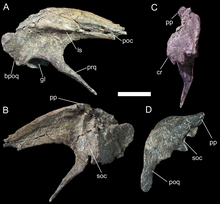
The holotype of Iguanacolossus, UMNH VP 20205, was discovered by Donald D. DeBlieux in 2005, unearthed from the Yellow Cat Member of the Cedar Mountain Formation, Utah; dating from the Valanginian stage in the Early Cretaceous, it wasn't named and described until 2010 by Andrew T. McDonald, James I. Kirkland, Donald D. DeBlieux, Scott K. Madsen, Jennifer Cavin, Andrew R. C. Milner, and Lukas Panzarin, along with the genus Hippodraco, also from the Cedar Mountain Formation. UMNH VP 20205 is assigned to a single individual, including skull elements: fragmented predentary, partial right maxilla, right squamosal, teeth, right and left quadrates. Body remains compromise: vertebrae (cervical, dorsal and caudal), chevrons, ribs, right scapula, right ilium, right pubis, right metatarsals and left fibula. The generic name, Iguanacolossus, is a combination of the reptile genus "Iguana", and the Latin word "colossus" (meaning colossal and/or giant) in relation to the iconic Iguana-like teeth of iguanodontians and the notorious large body size of the specimen. The specific name, "fortis", means mighty. The binomialmeans "Mighty Iguana Colossus".[1] Additional findings at the Doelling's Bowl site are currently on revision, compromising mostly juvenile material based on lower jaws and humerus. Other remains include a large femur and pubis.[2]
Description

Iguanacolossus is a large, robust iguanodontid, probably reaching 9 m (30 ft) long, or a size similar to Iguanodon, with an estimated weight between 1 to 4 t (2,204.6 to 8,818.5 lb).[3] Gregory Paul estimated its length at 9 m (30 ft) and its weight at 5 t (11,000 lb).[4][1] According to McDonald and colleagues, Iguanacolossus differs from other iguanodontians in having a contact surface for supraoccipital on caudomedial process of squamosal curved in caudal view, cranial pubic process with concave dorsal margin but little expansion of its cranial end, postorbital process of the squamosal mediolaterally compressed and blade-like, pubis tapers to a blunt point, cranial extremity of preacetabular process of ilium modified into horizontal boot, axial neural spine blade-like and semi-circular in profile, and the dorsal margin of ilium straight.[1]

It had stock metatarsals and a prominent left fibula measuring 63.0 cm (24.8 in). The maxilla preserves 14 alveoli, the presence of two concave surfaces suggest an elliptical and elongate antorbital fossa. Based on comparisons with Camptosaurus and Dakotadon, the two isolated teeth are clasiffied as dentary and maxillary, having a shield-shaped crown and lozenge-shapedcrown respectively. The scapular bone is almost complete; a denticle is preserved on the predentary, various vertebrae indicate a very iguanodontian-like body shape, specially dorsal vertebrae. The two right metatarsals are classified as metatarsals III and IV based on Camptosaurus and Iguanodon. The right pubis shows derived and plesiomorphicfeatures, seen on related iguanodontians.[1]
Classification

Iguanacolossus was placed in the Iguanodontia, being a styracosternan, a basal subgroup containing the Hadrosauridae and all dinosaurs more closely related to hadrosaurids than to camptosaurids. Below are the results obtained in the phylogeneticanalysis performed by its describers in 2010:[1]
Paleoecology
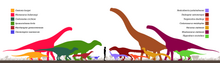
Iguanacolossus was recovered in the Yellow Cat Member from the Cedar Mountain Formation. However, this Member is divided in two beds: Upper and Lower Yellow Cat; Iguanacolossus was unearthed from the Lower bed, where it shared its environment with Theropods: Falcarius, Geminiraptor and Yurgovuchia. The sauropod Mierasaurus and the turtle Naomichelys.[5][6] There are also indeterminate Goniopholidids crocodiles known from the Lower Yellow Cat.[5]
The other paleofauna is from the Upper Yellow Cat, which includes: Aquatilavipes; Sauropods: Cedarosaurus and Moabosaurus; Iguanodontians: Cedrorestes and Hippodraco; Theropods: Martharaptor and Utahraptor; the nodosaurid Gastonia; Turtles: Glyptops and Trinitichelys; Fish: Ceratodus, Semionotus and indeterminate remains of Hybodontids and Polyacrodontids sharks.[5] Lastly, the mammalCifelliodon.[7] Additional unnamed genera is known from this bed: U. Sail-backed Iguanodont,[8] U. Eudromaeosaur and Velociraptorine,[9] U. Goniopholidids, U. Mesoeucrocodylian[5] and U. Neochoristodere.[10]
| This article uses material from the Wikipedia article Metasyntactic variable, which is released under the Creative Commons Attribution-ShareAlike 3.0 Unported License. |