Isisaurus (named after the Indian Statistical Institute[1]) is a genus of titanosauriandinosaur from the Late Cretaceous periodfrom what is now India.

Discovery and Naming
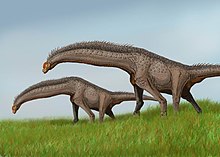
The type specimen of Isisaurus colberti, ISI R 335/1-65, was originally described and named as Titanosaurus colberti by Sohan Lal Jain and Saswati Bandyopadhyay in 1997, the specific name honouring Edwin Harris Colbert,[2][3] but was placed in its own genus, by Wilson and Upchurch, in 2003.[4] It had a short, vertically directed neck and long forelimbs,[citation needed] making it considerably different from other sauropods. The humerus is 148 centimetres long.[2] Based on this specimen, Isisaurus would have grown to about 18 meters (60 feet) in length and weighed about 14,000 kg (15 tons).[5]
Isisaurus is known from much better remains than most titanosaurs. Most of its postcranialskeleton is known. The skeletal material Jain and Bandyopadhyay found between 1984 and 1986 was "in associated and mostly articulated condition;" it included cervical, dorsal, sacral and caudal vertebrae, ribs, pelvis, scapula, coracoid, left forelimb and other bones, though skull, hindlimb and foot bones were missing.[2] The site locality is Dongargaon Hill, which is in a Maastrichtiancrevasse splay claystone in the Lameta Formation of India.[3] Dongargaon Hill (20.212318N,79.090709E) is located near Warora, in Chandrapur District, Maharashtra.
Description
There are two types of sauropod skulls from the Maastrichtian of India, the first type is from Jainosaurus and the other is from Isisaurus. While Jainosaurus had a broad and flat cranium, the skull of Isisaurus was robust and compact. Additionally, the angle between the occipital bone and occipital condyle is different in the two taxa. In the specimen from Dongargaon it is equal to 120°. The cranium of Isisaurus resembles in that matter the skulls of Diplodocus and Apatosaurus (genera belonging to the Diplodocidae), but the bone modifications are different.[6]
Palaeobiology
Fungus in coprolites believed to have been voided by Isisaurus indicate that it ate leaves from several species of tree, since these fungi are known to be pathogens which infect tree leaves.[7]
Paleoecology
Isisaurus lived in the area belonging nowadays to India[8] during the Maastrichtian(which is the uppermost stage of Late Cretaceous epoch).[9] Its remains are the most complete among the Cretaceous dinosaurs known from that region.[10] Khosla et al. (2003) listed the following Indian sauropods:[11]
- Titanosaurus indicus
- Titanosaurus blanfordi
- Titanosaurus rahiolensis
- Jainosaurus septentrionalis.
Wilson et al. (2009) listed only two Indian titanosaurs, Isisaurus and its distant relative, Jainosaurus. Isisaurus and Jainosaurus lived sympatrically in the area of nowadays middle and western India, Isisaurus being also present in the area of western Pakistan.[6]
| This article uses material from the Wikipedia article Metasyntactic variable, which is released under the Creative Commons Attribution-ShareAlike 3.0 Unported License. |