Mussaurus (meaning "mouse lizard") is a genus of herbivorous sauropodomorphdinosaur that lived in southern Argentinaduring the Late Triassic, about 215 million years ago. It receives its name from the small size of the skeletons of juvenile and infant individuals, which were once the only known specimens of the genus. However, since Mussaurus is now known from adult specimens,[1] the name is something of a misnomer; adults possibly reached 6 metres (20 ft) in length and weighed more than 1,000 kilograms (2,200 lb).[2] Mussaurus possesses anatomical features suggesting a close, possibly transitional evolutionary relationship with true sauropods.[3]

Discovery

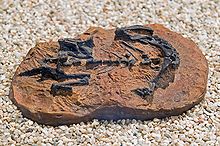
Infant and juvenile fossils of Mussaurus were first discovered by an expedition led by Jose Bonaparte during the 1970s to the Laguna Colorada Formation.[3] There the team found fossilized eggs and hatchlings, which added insight into the reproductive strategies of Mussaurus and other sauropodomorph dinosaurs.[3] The first adult specimens of Mussaurus were described in 2013. Some of these specimens had first been described in 1980 and were originally attributed to the genus Plateosaurus.[1]
Phylogeny
Previous to the discovery of adult specimens of Mussaurus, the phylogenetic position of this taxon was difficult to establish. Infant and juvenile fossils are known to show more basal traits than adult specimens of the same taxon. Furthermore, the recently discovered one subadult and three adult specimens assigned to Mussaurus are more complete than other material assigned to it. Therefore, a cladistic analysis of basal sauropodomorphs performed by Otero and Pol (2013) to test the phylogenetic relationships of Mussaurus, included information only from adult specimens. The following cladogram is simplified after their analysis (relationships outside Plateosauria are not shown).[1]
Palaeobiology

Reproduction
Mussaurus specimens have been found in association with nests that are believed to contain multiple eggs apiece. The skeletons of Mussaurus infants were small, only six inches long excluding the tail, but a total of 20 to 37 centimetres (7.9 to 14.6 in) long. This is about the size of a small lizard. Juveniles differed from adults in proportion in addition to size and mass. As is common for dinosaurs, juvenile Mussaurus had tall skulls with short snouts and large eyes.[3]
These proportions are common in many infant vertebrates and are often associated with species that provide parental care during the vulnerable early stages of life. Adults are expected to have longer snouts and necks, as typical in early sauropodomorphs.
Locomotion
A study published in May 2019 shows that while M. patagonicus probably walked on all four limbs (was quadrupedal) during the first year of its life, changes in the relative proportions of its body during growth (ontogeny) caused its centre of mass to move backwards towards its pelvis, resulting in the animal adopting a two-legged (bipedal) stance later in life.[2][4]
| This article uses material from the Wikipedia article Metasyntactic variable, which is released under the Creative Commons Attribution-ShareAlike 3.0 Unported License. |