Plateosauridae is a family of plateosauriansauropodomorphs from the Late Triassic of Europe, Africa and Asia.[1][2] Although several dinosaurs have been classified as plateosaurids over the years, the family Plateosauridae is now restricted to Plateosaurus. In another study, Yates (2003) sunk Sellosaurus into Plateosaurus (as P. gracilis).
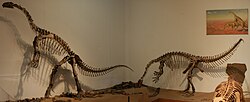

Classification
Plateosauridae, which was first named by Othniel Charles Marsh in 1895, is a stem-based taxon and it was defined by Sereno, 1998 as all animals more closely related to Plateosaurus engelhardti than to Massospondylus carinatus.[3] Galton and Upchurch, 2004 proposed the following definition: all animals more closely related to Plateosaurus engelhardti than to Massospondylus carinatus and Yunnanosaurus huangi. Yates, 2007 defined it as all animals more closely related to Plateosaurus engelhardti than to Diplodocus longus.[2] Recent cladistic analyses suggest that the clade Prosauropoda, which was named by Huene in 1920 and was defined by Sereno, 1998 as all animals more closely related to Plateosaurus engelhardti than to Saltasaurus loricatus,[3] is a synonym of Plateosauridae as both contain the same taxa.[2] Plateosauridae was recovered as a monophyletic group in the large phylogenetic analysis of early dinosaurs that was presented by Baron, Norman & Barrett (2017) in the journal Nature. In this analysis, the group was found to be sister to Massopodawithin the clade Plateosauria.[4]
| This article uses material from the Wikipedia article Metasyntactic variable, which is released under the Creative Commons Attribution-ShareAlike 3.0 Unported License. |