Priconodon (meaning "saw cone tooth"[1]) is an extinct genus of dinosaur (perhaps nodosaurid), known from its large teeth. Its remains have been found in the Aptian-Albianage Lower Cretaceous Arundel Formation of Muirkirk, Prince George's County, Maryland, USA.

History
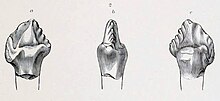
O. C. Marsh named the genus for USNM 2135, a large worn tooth from what was then called the Potomac Formation. As ankylosaurianswere by and large unknown at the time, he compared it to Diracodon (=Stegosaurus) teeth.[2] It was not identified as an ankylosaurian until Walter Coombs assigned it to Nodosauridae in 1978.[3]
In 1998 Kenneth Carpenter and James Kirkland, in a review of North American Lower Cretaceous ankylosaurs, considered it tentatively valid as an unusually large nodosaurid, larger than all those described before.[4] Carpenter (2001) retained it as a valid nodosaurid, but did not employ it in his phylogenetic analysis.[5] Vickaryous et al.(2004), in a review of armored dinosaurs, considered it to be dubious without comment.[6] West and Tibert, however, followed this with a preliminary account of a morphometric study that found it to be a unique genus.[7]
Material

Carpenter and Kirkland (1998) listed 12 additional teeth from the same area as the holotype tooth, and tentatively added a robust tibia (USNM 9154) to the genus. They found the lack of armor found in the Arundel to be peculiar, but noted that fossils are rare in that formation anyway.[4]
Paleobiology
As a nodosaurid, Priconodon would have been a slow, armored, quadrupedal herbivore.[6] It would have been a large nodosaurid, but since only teeth are definitely known for the genus, size estimation has not been done.
| This article uses material from the Wikipedia article Metasyntactic variable, which is released under the Creative Commons Attribution-ShareAlike 3.0 Unported License. |