Proceratosaurus is a genus of small-sized (~3 metres (9.8 ft) long) carnivorous theropoddinosaur from the Middle Jurassic(Bathonian) of England.[1] Its name refers to how it was originally thought to be an ancestor of Ceratosaurus, due to the partially preserved portion of the crest of Proceratosaurus superficially resembling the small crest of Ceratosaurus.[2] Now, however, it is considered a coelurosaur, specifically a member of the family Proceratosauridae, and amongst the earliest known members of the clade Tyrannosauroidea.[3]
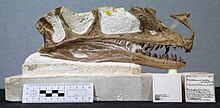

The type specimen is held in the Natural History Museum in London and was recovered in 1910 from oolitic limestone of the White Limestone Formation near Minchinhamptonwhile excavating for a reservoir.[4]
Classification

Arthur Smith Woodward, who initially studied Proceratosaurus, originally thought it to be an ancestor of the Late Jurassic Ceratosaurus, due to the similar shape of the preserved portion of the cranial crest with that of Ceratosaurus.[5] Later study during the 1930s by Friedrich von Huene supported this interpretation, and Huene thought both dinosaurs represented members of the group Coelurosauria.[6]
It was not until the late 1980s, after Ceratosaurus had been shown to be a much more primitive theropod and not a coelurosaur, that the classification of Proceratosaurus was again re-examined. Gregory S. Paul suggested that it was a close relative of Ornitholestes, again mainly due to the crest on the nose (though the idea that Ornitholestes bore a nasal crest was later disproved). Paul considered both Proceratosaurus and Ornitholestes to be neither ceratosaurs nor coelurosaurs, but instead primitive allosauroids. Furthermore, Paul considered the much larger dinosaur Piveteausaurus to be the same genus as Proceratosaurus, making Piveteausaurus a junior synonym.[7] However, no overlapping bones between the two had yet been exposed from the rock around their fossils, and future study showed that they were indeed distinct.[8]
Several phylogenetic studies in the early 21st century finally found Proceratosaurus (as well as Ornitholestes) to be a coelurosaur, only distantly related to the ceratosaurids and allosauroids, though one opinion published in 2000 considered Proceratosaurusa ceratosaurid without presenting supporting evidence. Phylogenetic analyses by Thomas R. Holtz Jr. in 2004 also placed Proceratosaurusamong the coelurosaurs, though with only weak support, and again found an (also weakly supported) close relationship with Ornitholestes.[8]
The first major re-evaluation of Proceratosaurus and its relationships was published in 2010 by Oliver Rauhut and colleagues. Their study concluded that Proceratosaurus was in fact a coelurosaur, and moreover a tyrannosauroid, a member of the lineage leading to the giant tyrannosaurs of the Late Cretaceous. Furthermore, they found that Proceratosaurus was most closely related to the Chinese tyrannosauroid Guanlong. They named the clade containing these two dinosaurs the Proceratosauridae, defined as all theropods closer to Proceratosaurus than to Tyrannosaurus, Allosaurus, Compsognathus, Coelurus, Ornithomimus, or Deinonychus.[8]
Below is a cladogram by Loewen et al. in 2013.[9]

Palaeobiology
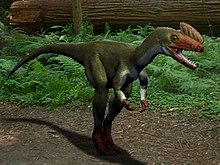
Proceratosaurus possessed a nasal crest, which may have served as a display organ but also possibly served to reduce bending stresses on the skull when biting. This may indicate Proceratosaurus used a puncture-pull strategy for hunting prey. However, Proceratosaurus was likely not a big game hunter, lacking the bone-crushing teeth and extremely powerful bites of the tyrannosaurids. Instead, it possessed an elongate skull, commonly found in basal coelurosaurs and basal tyrannosauroids.[8]
| This article uses material from the Wikipedia article Metasyntactic variable, which is released under the Creative Commons Attribution-ShareAlike 3.0 Unported License. |