Rebbachisauridae is a family of sauropoddinosaurs known from fragmentary fossilremains from the Cretaceous of South America, Africa, North America, Europe and Central Asia.
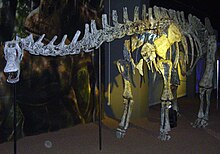

Taxonomy
In 1990 sauropod specialist Jack McIntosh included the first known rebbachisaurid genus, the giant North African sauropod Rebbachisaurus, in the family Diplodocidae, subfamily Dicraeosaurinae, on the basis of skeletal details. With the discovery in subsequent years of a number of additional genera, it was realised that Rebbachisaurusand its relatives constituted a distinct group of dinosaurs. In 1997 the Argentine paleontologist José Bonaparte described the family Rebbachisauridae, and in 2011 Whitlock defined two new subfamilies within the group: Nigersaurinae and Limaysaurinae. The cladogram of the Rebbachisauridae according to Carballido et al. (2012) is shown below:[2]
Cladogram after Fanti et al., 2015.[3]

Evolutionary relationships and characteristics

Although all authorities agree that the rebbachisaurids are members of the superfamily Diplodocoidea, they lack the bifid (divided) cervical neural spines that characterise the diplodocids and dicraeosaurids, and for this reason are considered more primitive than the latter two groups. It is not yet known whether they share the distinctive whip-tail of the latter two taxa.
Rebbachisaurids are distinguished from other sauropods by their distinctive teeth, which have low angle, internal wear facets and asymmetrical enamel.
Unique among sauropods, at least some rebbachisaurids (such as Nigersaurus) are characterised by the presence of tooth batteries, similar to those of hadrosaur and ceratopsian dinosaurs. Such a feeding adaptation has thus developed independently three times among the dinosaurs.
So far, rebbachisaurids are known only from the middle and early part of the Late Cretaceous. They constitute the last known representatives of this clade, and lived alongside the titanosaurs until fairly late in the Cretaceous.
| This article uses material from the Wikipedia article Metasyntactic variable, which is released under the Creative Commons Attribution-ShareAlike 3.0 Unported License. |