Rugops (meaning "wrinkle face") is a genus of abelisaurid theropod dinosaur that inhabited what is now Africa approximately 95 million years ago, during the Cenomanian stage of the Late Cretaceous.


Description


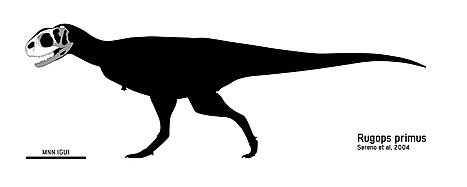
Though known only from a partial skull found in the Echkar Formation and a left maxilla from the Kem Kem Beds, Rugops was initially estimated as being 6 metres (19.7 ft) long and 750 kilograms (1,650 lb) in weight based on comparisons with its relatives.[1] Later estimates suggest a revised length of 4.4 metres (14.4 ft).[2] At the same time other authors suggest that it measured 5.3 metres (17.4 ft) long and 410 kilograms (900 lb) in weight.[3] The skull length of Rugops was about 31.5 centimetres (12.4 in).[4] Paul Sereno, who led the team that discovered the fossil, said "It's not the kind of head designed for fighting or bone-crushing", suggesting that it may have been a scavenger.[5] The top of the skull bears two rows of seven holes, each of unknown purpose, although Sereno has speculated that they may have anchored some kind of display crest or horns; based on the presence of grooves for blood vessels forming a pathway into these pits.[4]
Like other abelisaurids, Rugops likely had very short, or even vestigial arms. These were probably useless in fighting, and may have only been used to counterbalance the dinosaur's head.[citation needed]
Paleoecology
The discovery of Rugops's skull in Niger in 2000 was a crucial breakthrough in the understanding of the evolution of theropods in that area, and demonstrates that this landmass was still united with Gondwana at that stage in history. It lived in the same locality and geological time period as Spinosaurus, Carcharodontosaurus, and Deltadromeus.[4]
| This article uses material from the Wikipedia article Metasyntactic variable, which is released under the Creative Commons Attribution-ShareAlike 3.0 Unported License. |