Titanosaurs (or titanosaurians; members of the group Titanosauria) were a diverse group of sauropod dinosaurs, including genera from Africa, Asia, South America, North America, Europe, Australia and Antarctica. The titanosaurians were the last surviving group of long-necked sauropods, with taxa still thriving at the time of the extinction event at the end of the Cretaceous. This group includes some of the largest land animals known to have ever existed, such as Patagotitan—estimated at 37 m (121 ft) long[1] with a weight of 69 tonnes (76 tons)[2]—and the comparably-sized Argentinosaurus and Puertasaurus from the same region.
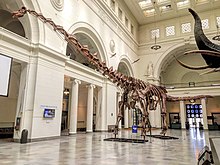

The group's name alludes to the mythologicalTitans of ancient Greek mythology, via the type genus (now considered a nomen dubium)Titanosaurus. Together with the brachiosaurids and relatives, titanosaurians make up the larger sauropod cladeTitanosauriformes. Titanosaurs have long been a poorly-known group, and the relationships between titanosaur species are still not well-understood.
Description
Classification
Paleobiology
Diet
Fossilized dung associated with late Cretaceous titanosaurids from India has revealed phytoliths, silicified plant fragments, that offer clues to a broad, unselective plant diet. Besides the plant remains that might have been expected, such as cycads and conifers, discoveries published in 2005[65]revealed an unexpectedly wide range of monocotyledons, including palms and grasses (Poaceae), including ancestors of rice and bamboo, which has given rise to speculation that herbivorous dinosaurs and grasses co-evolved.
Nesting
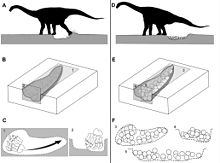
A large titanosaurid nesting ground was discovered in Auca Mahuevo, in Patagonia, Argentina and another colony has reportedly been discovered in Spain. Several hundred female saltasaurs dug holes with their back feet, laid eggs in clutches averaging around 25 eggs each, and buried the nests under dirt and vegetation. The small eggs, about 11–12 centimetres (4.3–4.7 in) in diameter, contained fossilised embryos, complete with skin impressions. The impressions showed that titanosaurs were covered in a mosaic armour of small bead-like scales.[5] The huge number of individuals gives evidence of herdbehavior, which, along with their armor, could have helped provide protection against large predators such as Abelisaurus.[66]
Range

The titanosaurs were the last great group of sauropods, which existed from about 136[67] to 66 million years ago, before the Cretaceous–Paleogene extinction event, and were the dominant herbivores of their time.[citation needed] The fossil evidence suggests they replaced the other sauropods, like the diplodocids and the brachiosaurids, which died out between the late Jurassic and the mid-Cretaceous Periods.
Titanosaurs were widespread. In December 2011, Argentine scientists announced titanosaur fossils had been found on Antarctica—meaning that titanosaur fossils have been found on all continents. They are especially numerous in the southern continents (then part of the supercontinent of Gondwana). Australia had titanosaurs around 96 million years ago: fossils have been discovered in Queensland of a creature around 25 metres (82 ft) long.[68][69] Remains have also been discovered in New Zealand.[70]One of the largest ever titanosaur footprints was discovered in the Gobi desert in 2016.[71]One of the oldest remains of this group was found from the Valley of the Dinosaurs, Paraíba state of Brazil, representing a 136-million-year-old subadult individual.[67]
Paleopathology
A titanosaur fossil from Brazil suggests that individuals of various genera were susceptible to diseases such as osteomyelitisand parasite infestations. The specimen hails from the late cretaceous Adamantina Formation, and was described in October 2020 in the journal Cretaceous Research by Aline Ghilardi et al,. Examination of the titanosaur's bones revealed what appear to be parasitic blood worms similar to the prehistoric Paleoleishmania but are 10-100 times larger, that seemed to have caused the osteomyelitis. If correct, the fossil would be the first known instance of an aggressive case of osteomyelitis being caused by blood worms in a prehistoric animal.[72][73][74]
| This article uses material from the Wikipedia article Metasyntactic variable, which is released under the Creative Commons Attribution-ShareAlike 3.0 Unported License. |