Turiasaurus (meaning "Turia lizard") is a genus of sauropod dinosaurs. It is known from a single fossil specimen representing the species Turiasaurus riodevensis, found in the Kimmeridgian Villar del Arzobispo Formationof Teruel, Spain.
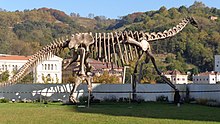

Description

Turiasaurus is believed to be the largest dinosaur ever found in Europe, and is among the largest dinosaurs known. It was originally estimated at 36–39 metres (118–128 ft) in length and with a weight of 40 to 48 tonnes,[1]the combined weight of six or seven adult male elephants. More recent estimates suggest a length of 30 metres (98 ft) in length, but a comparable weight of 50 tonnes.[2] The length of its skull is 70 centimetres, which is not too large. According to the paleontologistLuis Alcalá, this is because a larger head might have caused Turiasaurus to break its neck.[3]
Phylogenetic analysis shows that Turiasauruslies outside of the Neosauropoda division and belongs to a new clade, Turiasauria, together with Losillasaurus and Galveosaurus.[1]
History


Fragmentary remains of this animal, including an articulated left forelimb (holotype), skull fragments, teeth, vertebrae and ribs, have been found in terrestrial deposits of the Villar del Arzobispo Formation of Riodeva (Teruel Province, Spain). A forelimb from Portugal.[4] is now seen as Zby atlanticus.[5]The type species, Turiasaurus riodevensis, was formally described by Royo-Torres, Cobos & Alcala, in 2006.[1] In the early 2010s, excavations were made east of Madrid that uncovered the most complete fossil of such creatures in the whole world.[6]
| This article uses material from the Wikipedia article Metasyntactic variable, which is released under the Creative Commons Attribution-ShareAlike 3.0 Unported License. |