Tyrannosaurus[nb 1] is a genus of tyrannosaurid theropod dinosaur. The speciesTyrannosaurus rex (rex meaning "king" in Latin), often called T. rex or colloquially T-Rex, is one of the best represented of the large theropods. Tyrannosaurus lived throughout what is now western North America, on what was then an island continent known as Laramidia. Tyrannosaurus had a much wider range than other tyrannosaurids. Fossils are found in a variety of rock formations dating to the Maastrichtian age of the Upper Cretaceous period, 68 to 66 million years ago. It was the last known member of the tyrannosaurids and among the last non-avian dinosaurs to exist before the Cretaceous–Paleogene extinction event.


Like other tyrannosaurids, Tyrannosaurus was a bipedal carnivore with a massive skull balanced by a long, heavy tail. Relative to its large and powerful hind limbs, the forelimbs of Tyrannosaurus were short but unusually powerful for their size, and they had two clawed digits. The most complete specimen measures up to 12.3 meters (40 feet) in length, though T. rex could grow to lengths of over 12.3 m (40 ft), up to 3.96 m (13 ft) tall at the hips, and according to most modern estimates 8.4 metric tons (9.3 short tons) to 14 metric tons (15.4 short tons) in weight. Although other theropods rivaled or exceeded Tyrannosaurus rex in size, it is still among the largest known land predators and is estimated to have exerted the strongest bite force among all terrestrial animals. By far the largest carnivore in its environment, Tyrannosaurus rex was most likely an apex predator, preying upon hadrosaurs, juvenile armored herbivores like ceratopsians and ankylosaurs, and possibly sauropods. Some experts have suggested the dinosaur was primarily a scavenger. The question of whether Tyrannosaurus was an apex predator or a pure scavenger was among the longest debates in paleontology. Most paleontologists today accept that Tyrannosaurus was both an active predator and a scavenger.
Specimens of Tyrannosaurus rex include some that are nearly complete skeletons. Soft tissue and proteins have been reported in at least one of these specimens. The abundance of fossil material has allowed significant research into many aspects of its biology, including its life history and biomechanics. The feeding habits, physiology, and potential speed of Tyrannosaurus rex are a few subjects of debate. Its taxonomy is also controversial, as some scientists consider Tarbosaurus bataar from Asia to be a second Tyrannosaurus species, while others maintain Tarbosaurus is a separate genus. Several other genera of North American tyrannosaurids have also been synonymizedwith Tyrannosaurus.
As the archetypal theropod, Tyrannosaurushas been one of the best-known dinosaurs since the early 20th century and has been featured in film, advertising, postal stamps, and many other media.
History of research
Description
Classification

Tyrannosaurus is the type genus of the superfamily Tyrannosauroidea, the familyTyrannosauridae, and the subfamily Tyrannosaurinae; in other words it is the standard by which paleontologists decide whether to include other species in the same group. Other members of the tyrannosaurine subfamily include the North American Daspletosaurus and the AsianTarbosaurus,[18][57] both of which have occasionally been synonymized with Tyrannosaurus.[58] Tyrannosaurids were once commonly thought to be descendants of earlier large theropods such as megalosaursand carnosaurs, although more recently they were reclassified with the generally smaller coelurosaurs.[47]

In 1955, Soviet paleontologist Evgeny Maleevnamed a new species, Tyrannosaurus bataar, from Mongolia.[59] By 1965, this species had been renamed Tarbosaurus bataar.[60]Despite the renaming, many phylogeneticanalyses have found Tarbosaurus bataar to be the sister taxon of T. rex,[57] and it has often been considered an Asian species of Tyrannosaurus.[47][61][62] The discovery of the tyrannosaurid Lythronax further indicates that Tarbosaurus and Tyrannosaurus are closely related, forming a clade with fellow Asian tyrannosaurid Zhuchengtyrannus, with Lythronax being their sister taxon.[63][64] A further study from 2016 by Steve Brusatte, Thomas Carr and colleagues, also indicates that Tyrannosaurus may have been an immigrant from Asia, as well as a possible descendant of Tarbosaurus.[65]
In 2001, various tyrannosaurid teeth and a metatarsal unearthed in a quarry near Zhucheng, China were assigned by Chinese paleontologist Hu Chengzhi to the newly erected Tyrannosaurus zhuchengensis. However, in a nearby site, a right maxilla and left jawbone were assigned to the newly erected tyrannosaurid genus Zhuchengtyrannus in 2011, and it is possible T. zhuchengensis is synonymous with Zhuchengtyrannus. In any case, T. zhuchengensis is considered to be a nomen dubium as the holotype lacks diagnosticfeatures below the level Tyrannosaurinae.[66]
Below is the cladogram of Tyrannosauridae based on the phylogenetic analysis conducted by Loewen and colleagues in 2013.[63]


Nanotyrannus
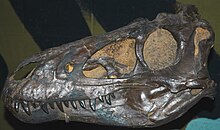
Other tyrannosaurid fossils found in the same formations as T. rex were originally classified as separate taxa, including Aublysodon and Albertosaurus megagracilis,[58] the latter being named Dinotyrannus megagracilis in 1995.[67] These fossils are now universally considered to belong to juvenile T. rex.[68] A small but nearly complete skull from Montana, 60 centimeters (2.0 ft) long, might be an exception. This skull, CMNH 7541, was originally classified as a species of Gorgosaurus (G. lancensis) by Charles W. Gilmore in 1946.[69] In 1988, the specimen was re-described by Robert T. Bakker, Phil Currie, and Michael Williams, then the curator of paleontology at the Cleveland Museum of Natural History, where the original specimen was housed and is now on display. Their initial research indicated that the skull bones were fused, and that it therefore represented an adult specimen. In light of this, Bakker and colleagues assigned the skull to a new genus named Nanotyrannus (meaning "dwarf tyrant", for its apparently small adult size). The specimen is estimated to have been around 5.2 meters (17 ft) long when it died.[70]However, In 1999, a detailed analysis by Thomas Carr revealed the specimen to be a juvenile, leading Carr and many other paleontologists to consider it a juvenile T. rexindividual.[71][72]
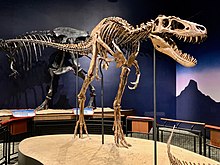
In 2001, a more complete juvenile tyrannosaur (nicknamed "Jane", catalog number BMRP 2002.4.1), belonging to the same species as the original Nanotyrannus specimen, was uncovered. This discovery prompted a conference on tyrannosaurs focused on the issues of Nanotyrannus validity at the Burpee Museum of Natural History in 2005. Several paleontologists who had previously published opinions that N. lancensis was a valid species, including Currie and Williams, saw the discovery of "Jane" as a confirmation that Nanotyrannus was, in fact, a juvenile T. rex.[73][74][75] Peter Larson continued to support the hypothesis that N. lancensis was a separate but closely related species, based on skull features such as two more teeth in both jaws than T. rex; as well as proportionately larger hands with phalanges on the third metacarpal and different wishbone anatomy in an undescribed specimen. He also argued that Stygivenator, generally considered to be a juvenile T. rex, may be a younger Nanotyrannusspecimen.[76][77] Later research revealed that other tyrannosaurids such as Gorgosaurusalso experienced reduction in tooth count during growth,[71] and given the disparity in tooth count between individuals of the same age group in this genus and Tyrannosaurus, this feature may also be due to individual variation.[72] In 2013, Carr noted that all of the differences claimed to support Nanotyrannushave turned out to be individually or ontogenetically variable features or products of distortion of the bones.[78]

In 2016, analysis of limb proportions by Persons and Currie suggested Nanotyrannusspecimens to have differing cursoriality levels, potentially separating it from T. rex.[79]However, paleontologist Manabu Sakomoto has commented that this conclusion may be impacted by low sample size, and the discrepancy does not necessarily reflect taxonomic distinction.[80] In 2016, Joshua Schmerge argued for Nanotyrannus' validity based on skull features, including a dentary groove in BMRP 2002.4.1's skull. According to Schmerge, as that feature is absent in T. rexand found only in Dryptosaurus and albertosaurines, this suggests Nanotyrannusis a distinct taxon within the Albertosaurinae.[81] The same year, Carr and colleagues noted that this was not sufficient enough to clarify Nanotyrannus' validity or classification, being a common and ontogenetically variable feature among tyrannosauroids.[82]
A 2020 study by Holly Woodward and colleagues showed the specimens referred to Nanotyrannus were all ontogenetically immature and found it probable that these specimens belonged to T. rex.[83] The same year, Carr published a paper on T. rex's growth history, finding that CMNH 7541 fit within the expected ontogenetic variation of the taxon and displayed juvenile characteristics found in other specimens. It was classified as a juvenile, under 13 years old with a skull less than 80 cm (31 in). No significant sexual or phylogenetic variation was discernible among any of the 44 specimens studied, with Carr stating that characters of potential phylogenetic importance decrease throughout age at the same rate as growth occurs.[84]Discussing the paper's results, Carr described how all "Nanotyrannus" specimens formed a continual growth transition between the smallest juveniles and the subadults, unlike what would be expected if it were a distinct taxon where the specimens would group to the exclusion of Tyrannosaurus. Carr concluded that "the 'nanomorphs' are not all that similar to each other and instead form an important bridge in the growth series of T. rex that captures the beginnings of the profound change from the shallow skull of juveniles to the deep skull that is seen in fully-developed adults."[85]
Paleobiology
Life history

The identification of several specimens as juvenile T. rex has allowed scientists to document ontogenetic changes in the species, estimate the lifespan, and determine how quickly the animals would have grown. The smallest known individual (LACM 28471, the "Jordan theropod") is estimated to have weighed only 30 kg (66 lb), while the largest, such as FMNH PR2081 (Sue) most likely weighed about 5,650 kg (12,460 lb). Histologicanalysis of T. rex bones showed LACM 28471 had aged only 2 years when it died, while Sue was 28 years old, an age which may have been close to the maximum for the species.[38]
Histology has also allowed the age of other specimens to be determined. Growth curves can be developed when the ages of different specimens are plotted on a graph along with their mass. A T. rex growth curve is S-shaped, with juveniles remaining under 1,800 kg (4,000 lb) until approximately 14 years of age, when body size began to increase dramatically. During this rapid growth phase, a young T. rex would gain an average of 600 kg (1,300 lb) a year for the next four years. At 18 years of age, the curve plateaus again, indicating that growth slowed dramatically. For example, only 600 kg (1,300 lb) separated the 28-year-old Sue from a 22-year-old Canadian specimen (RTMP 81.12.1).[38] A 2004 histological study performed by different workers corroborates these results, finding that rapid growth began to slow at around 16 years of age.[86]
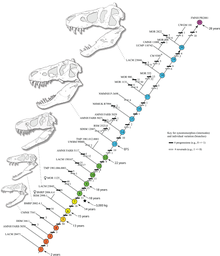
A study by Hutchinson and colleagues in 2011 corroborated the previous estimation methods in general, but their estimation of peak growth rates is significantly higher; it found that the "maximum growth rates for T. rex during the exponential stage are 1790 kg/year".[30] Although these results were much higher than previous estimations, the authors noted that these results significantly lowered the great difference between its actual growth rate and the one which would be expected of an animal of its size.[30] The sudden change in growth rate at the end of the growth spurt may indicate physical maturity, a hypothesis which is supported by the discovery of medullary tissue in the femur of a 16 to 20-year-old T. rex from Montana (MOR 1125, also known as B-rex). Medullary tissue is found only in female birds during ovulation, indicating that B-rex was of reproductive age.[87] Further study indicates an age of 18 for this specimen.[88] In 2016, it was finally confirmed by Mary Higby Schweitzer and Lindsay Zanno and colleagues that the soft tissue within the femur of MOR 1125 was medullary tissue. This also confirmed the identity of the specimen as a female. The discovery of medullary bone tissue within Tyrannosaurus may prove valuable in determining the sex of other dinosaur species in future examinations, as the chemical makeup of medullary tissue is unmistakable.[89] Other tyrannosaurids exhibit extremely similar growth curves, although with lower growth rates corresponding to their lower adult sizes.[90]
An additional study published in 2020 by Woodward and colleagues, for the journal Science Advances indicates that during their growth from juvenile to adult, Tyrannosauruswas capable of slowing down its growth to counter environmental factors such as lack of food. The study, focusing on two juvenile specimens between 13 and 15 years old housed at the Burpee Museum in Illinois, indicates that the rate of maturation for Tyrannosaurus was dependent on resource abundance. This study also indicates that in such changing environments, Tyrannosauruswas particularly well-suited to an environment that shifted yearly in regards to resource abundance, hinting that other midsize predators might have had difficulty surviving in such harsh conditions and explaining the niche partitioning between juvenile and adult tyrannosaurs. The study further indicates that Tyrannosaurus and the dubious genus Nanotyrannus are synonymous, due to analysis of the growth rings in the bones of the two specimens studied.[91][92]
Over half of the known T. rex specimens appear to have died within six years of reaching sexual maturity, a pattern which is also seen in other tyrannosaurs and in some large, long-lived birds and mammals today. These species are characterized by high infant mortality rates, followed by relatively low mortality among juveniles. Mortality increases again following sexual maturity, partly due to the stresses of reproduction. One study suggests that the rarity of juvenile T. rex fossils is due in part to low juvenile mortality rates; the animals were not dying in large numbers at these ages, and thus were not often fossilized. This rarity may also be due to the incompleteness of the fossil recordor to the bias of fossil collectors towards larger, more spectacular specimens.[90] In a 2013 lecture, Thomas Holtz Jr. suggested that dinosaurs "lived fast and died young" because they reproduced quickly whereas mammals have long life spans because they take longer to reproduce.[93] Gregory S. Paul also writes that Tyrannosaurus reproduced quickly and died young, but attributes their short life spans to the dangerous lives they lived.[94]
Skin and possible filamentous feathering

The discovery of feathered dinosaurs led to debate regarding whether, and to what extent, Tyrannosaurus might have been feathered.[95][96] Filamentous structures, which are commonly recognized as the precursors of feathers, have been reported in the small-bodied, basal tyrannosauroid Dilong paradoxus from the Early Cretaceous Yixian Formation of China in 2004.[97] Because integumentary impressions of larger tyrannosauroids known at that time showed evidence of scales, the researchers who studied Dilong speculated that insulating feathers might have been lost by larger species due to their smaller surface-to-volume ratio.[97] The subsequent discovery of the giant species Yutyrannus huali, also from the Yixian, showed that even some large tyrannosauroids had feathers covering much of their bodies, casting doubt on the hypothesis that they were a size-related feature.[98] A 2017 study reviewed known skin impressions of tyrannosaurids, including those of a Tyrannosaurus specimen nicknamed "Wyrex" (BHI 6230) which preserves patches of mosaic scales on the tail, hip, and neck.[5] The study concluded that feather covering of large tyrannosaurids such as Tyrannosaurus was, if present, limited to the upper side of the trunk.[95]
A conference abstract published in 2016 posited that theropods such as Tyrannosaurushad their upper teeth covered in lips, instead of bare teeth as seen in crocodilians. This was based on the presence of enamel, which according to the study needs to remain hydrated, an issue not faced by aquatic animals like crocodilians.[54] A 2017 analytical study proposed that tyrannosaurids had large, flat scales on their snouts instead of lips.[52][99] However, there has been criticisms where it favors the idea for lips. Crocodiles do not really have flat scales but rather cracked keratinized skin, by observing the hummocky rugosity of tyrannosaurids, and comparing it to extant lizards they found that tyrannosaurids had squamose scales rather than a crocodillian-like skin.[100][101]
Sexual dimorphism

As the number of known specimens increased, scientists began to analyze the variation between individuals and discovered what appeared to be two distinct body types, or morphs, similar to some other theropod species. As one of these morphs was more solidly built, it was termed the 'robust' morph while the other was termed 'gracile'. Several morphological differences associated with the two morphs were used to analyze sexual dimorphism in T. rex, with the 'robust' morph usually suggested to be female. For example, the pelvis of several 'robust' specimens seemed to be wider, perhaps to allow the passage of eggs.[102] It was also thought that the 'robust' morphology correlated with a reduced chevron on the first tail vertebra, also ostensibly to allow eggs to pass out of the reproductive tract, as had been erroneously reported for crocodiles.[103]
In recent years, evidence for sexual dimorphism has been weakened. A 2005 study reported that previous claims of sexual dimorphism in crocodile chevron anatomy were in error, casting doubt on the existence of similar dimorphism between T. rexsexes.[104] A full-sized chevron was discovered on the first tail vertebra of Sue, an extremely robust individual, indicating that this feature could not be used to differentiate the two morphs anyway. As T. rex specimens have been found from Saskatchewan to New Mexico, differences between individuals may be indicative of geographic variation rather than sexual dimorphism. The differences could also be age-related, with 'robust' individuals being older animals.[48]
Only a single T. rex specimen has been conclusively shown to belong to a specific sex. Examination of B-rex demonstrated the preservation of soft tissue within several bones. Some of this tissue has been identified as a medullary tissue, a specialized tissue grown only in modern birds as a source of calcium for the production of eggshell during ovulation. As only female birds lay eggs, medullary tissue is only found naturally in females, although males are capable of producing it when injected with female reproductive hormones like estrogen. This strongly suggests that B-rex was female and that she died during ovulation.[87] Recent research has shown that medullary tissue is never found in crocodiles, which are thought to be the closest living relatives of dinosaurs, aside from birds. The shared presence of medullary tissue in birds and theropod dinosaurs is further evidence of the close evolutionary relationship between the two.[105]
Posture
Like many bipedal dinosaurs, T. rex was historically depicted as a 'living tripod', with the body at 45 degrees or less from the vertical and the tail dragging along the ground, similar to a kangaroo. This concept dates from Joseph Leidy's 1865 reconstruction of Hadrosaurus, the first to depict a dinosaur in a bipedal posture.[106] In 1915, convinced that the creature stood upright, Henry Fairfield Osborn, former president of the American Museum of Natural History, further reinforced the notion in unveiling the first complete T. rex skeleton arranged this way. It stood in an upright pose for 77 years, until it was dismantled in 1992.[107]
By 1970, scientists realized this pose was incorrect and could not have been maintained by a living animal, as it would have resulted in the dislocation or weakening of several joints, including the hips and the articulation between the head and the spinal column.[108]The inaccurate AMNH mount inspired similar depictions in many films and paintings (such as Rudolph Zallinger's famous mural The Age of Reptiles in Yale University's Peabody Museum of Natural History)[109] until the 1990s, when films such as Jurassic Parkintroduced a more accurate posture to the general public.[110] Modern representations in museums, art, and film show T. rex with its body approximately parallel to the ground with the tail extended behind the body to balance the head.[111]
To sit down, Tyrannosaurus may have settled its weight backwards and rested its weight on a pubic boot, the wide expansion at the end of the pubis in some dinosaurs. With its weight rested on the pelvis, it may have been free to move the hindlimbs. Getting back up again might have involved some stabilization from the diminutive forelimbs.[112][108] The latter known as Newman's pushup theory has been debated. Nonetheless, Tyrannosaurus was probably able to get up if it fell, which only would have required placing the limbs below the center of gravity, with the tail as an effective counterbalance.[113]
Arms
When T. rex was first discovered, the humeruswas the only element of the forelimb known.[6]For the initial mounted skeleton as seen by the public in 1915, Osborn substituted longer, three-fingered forelimbs like those of Allosaurus.[4] A year earlier, Lawrence Lambedescribed the short, two-fingered forelimbs of the closely related Gorgosaurus.[114] This strongly suggested that T. rex had similar forelimbs, but this hypothesis was not confirmed until the first complete T. rexforelimbs were identified in 1989, belonging to MOR 555 (the "Wankel rex").[115][116] The remains of Sue also include complete forelimbs.[48] T. rex arms are very small relative to overall body size, measuring only 1 meter (3.3 ft) long, and some scholars have labelled them as vestigial. The bones show large areas for muscle attachment, indicating considerable strength. This was recognized as early as 1906 by Osborn, who speculated that the forelimbs may have been used to grasp a mate during copulation.[8] It has also been suggested that the forelimbs were used to assist the animal in rising from a prone position.[108]
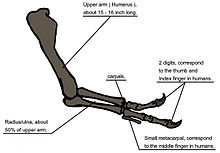
Another possibility is that the forelimbs held struggling prey while it was killed by the tyrannosaur's enormous jaws. This hypothesis may be supported by biomechanical analysis. T. rex forelimb bones exhibit extremely thick cortical bone, which has been interpreted as evidence that they were developed to withstand heavy loads. The biceps brachiimuscle of an adult T. rex was capable of lifting 199 kilograms (439 lb) by itself; other muscles such as the brachialis would work along with the biceps to make elbow flexion even more powerful. The M. biceps muscle of T. rex was 3.5 times as powerful as the human equivalent. A T. rex forearm had a limited range of motion, with the shoulder and elbow joints allowing only 40 and 45 degrees of motion, respectively. In contrast, the same two joints in Deinonychus allow up to 88 and 130 degrees of motion, respectively, while a human arm can rotate 360 degrees at the shoulder and move through 165 degrees at the elbow. The heavy build of the arm bones, strength of the muscles, and limited range of motion may indicate a system evolved to hold fast despite the stresses of a struggling prey animal. In the first detailed scientific description of Tyrannosaurus forelimbs, paleontologists Kenneth Carpenter and Matt Smith dismissed notions that the forelimbs were useless or that T. rex was an obligate scavenger.[117]
According to paleontologist Steven M. Stanley, the 1 metre (3.3 ft) arms of T. rexwere used for slashing prey, especially by using its claws to rapidly inflict long, deep gashes to its prey, although this concept is disputed by others believing the arms were used for grasping a sexual partner.[118]
Thermoregulation
As of 2014, it is not clear if Tyrannosaurus was endothermic ("warm-blooded"). Tyrannosaurus, like most dinosaurs, was long thought to have an ectothermic ("cold-blooded") reptilian metabolism. The idea of dinosaur ectothermy was challenged by scientists like Robert T. Bakker and John Ostrom in the early years of the "Dinosaur Renaissance", beginning in the late 1960s.[119][120] T. rex itself was claimed to have been endothermic ("warm-blooded"), implying a very active lifestyle.[36] Since then, several paleontologists have sought to determine the ability of Tyrannosaurus to regulate its body temperature. Histological evidence of high growth rates in young T. rex, comparable to those of mammals and birds, may support the hypothesis of a high metabolism. Growth curves indicate that, as in mammals and birds, T. rex growth was limited mostly to immature animals, rather than the indeterminate growthseen in most other vertebrates.[86]
Oxygen isotope ratios in fossilized bone are sometimes used to determine the temperature at which the bone was deposited, as the ratio between certain isotopes correlates with temperature. In one specimen, the isotope ratios in bones from different parts of the body indicated a temperature difference of no more than 4 to 5 °C (7 to 9 °F) between the vertebrae of the torso and the tibia of the lower leg. This small temperature range between the body core and the extremities was claimed by paleontologist Reese Barrick and geochemist William Showers to indicate that T. rex maintained a constant internal body temperature (homeothermy) and that it enjoyed a metabolism somewhere between ectothermic reptiles and endothermic mammals.[121] Other scientists have pointed out that the ratio of oxygen isotopes in the fossils today does not necessarily represent the same ratio in the distant past, and may have been altered during or after fossilization (diagenesis).[122]Barrick and Showers have defended their conclusions in subsequent papers, finding similar results in another theropod dinosaur from a different continent and tens of millions of years earlier in time (Giganotosaurus).[123] Ornithischian dinosaurs also showed evidence of homeothermy, while varanid lizards from the same formation did not.[124] Even if T. rex does exhibit evidence of homeothermy, it does not necessarily mean that it was endothermic. Such thermoregulation may also be explained by gigantothermy, as in some living sea turtles.[125][126][127] Similar to contemporary alligators, dorsotemporal fenestra in Tyrannosaurus's skull may have aided thermoregulation.[128]
Soft tissue
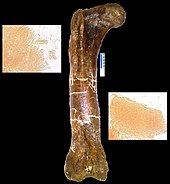
In the March 2005 issue of Science, Mary Higby Schweitzer of North Carolina State University and colleagues announced the recovery of soft tissue from the marrow cavity of a fossilized leg bone from a T. rex. The bone had been intentionally, though reluctantly, broken for shipping and then not preserved in the normal manner, specifically because Schweitzer was hoping to test it for soft tissue.[129] Designated as the Museum of the Rockies specimen 1125, or MOR 1125, the dinosaur was previously excavated from the Hell Creek Formation. Flexible, bifurcating blood vessels and fibrous but elastic bonematrix tissue were recognized. In addition, microstructures resembling blood cells were found inside the matrix and vessels. The structures bear resemblance to ostrich blood cells and vessels. Whether an unknown process, distinct from normal fossilization, preserved the material, or the material is original, the researchers do not know, and they are careful not to make any claims about preservation.[130] If it is found to be original material, any surviving proteins may be used as a means of indirectly guessing some of the DNA content of the dinosaurs involved, because each protein is typically created by a specific gene. The absence of previous finds may be the result of people assuming preserved tissue was impossible, therefore not looking. Since the first, two more tyrannosaurs and a hadrosaur have also been found to have such tissue-like structures.[129]Research on some of the tissues involved has suggested that birds are closer relatives to tyrannosaurs than other modern animals.[131]
In studies reported in Science in April 2007, Asara and colleagues concluded that seven traces of collagen proteins detected in purified T. rex bone most closely match those reported in chickens, followed by frogs and newts. The discovery of proteins from a creature tens of millions of years old, along with similar traces the team found in a mastodon bone at least 160,000 years old, upends the conventional view of fossils and may shift paleontologists' focus from bone hunting to biochemistry. Until these finds, most scientists presumed that fossilization replaced all living tissue with inert minerals. Paleontologist Hans Larsson of McGill University in Montreal, who was not part of the studies, called the finds "a milestone", and suggested that dinosaurs could "enter the field of molecular biology and really slingshot paleontology into the modern world".[132]
The presumed soft tissue was called into question by Thomas Kaye of the University of Washington and his co-authors in 2008. They contend that what was really inside the tyrannosaur bone was slimy biofilm created by bacteria that coated the voids once occupied by blood vessels and cells.[133] The researchers found that what previously had been identified as remnants of blood cells, because of the presence of iron, were actually framboids, microscopic mineral spheres bearing iron. They found similar spheres in a variety of other fossils from various periods, including an ammonite. In the ammonite, they found the spheres in a place where the iron they contain could not have had any relationship to the presence of blood.[134]Schweitzer has strongly criticized Kaye's claims and argues that there is no reported evidence that biofilms can produce branching, hollow tubes like those noted in her study.[135]San Antonio, Schweitzer and colleagues published an analysis in 2011 of what parts of the collagen had been recovered, finding that it was the inner parts of the collagen coil that had been preserved, as would have been expected from a long period of protein degradation.[136] Other research challenges the identification of soft tissue as biofilm and confirms finding "branching, vessel-like structures" from within fossilized bone.[137]
Speed

Scientists have produced a wide range of possible maximum running speeds for Tyrannosaurus: mostly around 9 meters per second (32 km/h; 20 mph), but as low as 4.5–6.8 meters per second (16–24 km/h; 10–15 mph) and as high as 20 meters per second (72 km/h; 45 mph), though it running this speed is very unlikely. Tyrannosaurus was a bulky and heavy carnivore so it is unlikely to run very fast at all compared to other theropods like Carnotaurus or Giganotosaurus.[138]Researchers have relied on various estimating techniques because, while there are many tracks of large theropods walking, none showed evidence of running.[139]
A 2002 report used a mathematical model (validated by applying it to three living animals: alligators, chickens, and humans; and eight more species, including emus and ostriches[139]) to gauge the leg muscle mass needed for fast running (over 40 km/h or 25 mph).[138] Scientists who think that Tyrannosaurus was able to run point out that hollow bones and other features that would have lightened its body may have kept adult weight to a mere 4.5 metric tons (5.0 short tons) or so, or that other animals like ostriches and horses with long, flexible legs are able to achieve high speeds through slower but longer strides.[139] Proposed top speeds exceeded 40 kilometers per hour (25 mph) for Tyrannosaurus, but were deemed infeasible because they would require exceptional leg muscles of approximately 40–86% of total body mass. Even moderately fast speeds would have required large leg muscles. If the muscle mass was less, only 18 kilometers per hour (11 mph) for walking or jogging would have been possible.[138] Holtz noted that tyrannosaurids and some closely related groups had significantly longer distalhindlimb components (shin plus foot plus toes) relative to the femur length than most other theropods, and that tyrannosaurids and their close relatives had a tightly interlocked metatarsus (foot bones).[140] The third metatarsal was squeezed between the second and fourth metatarsals to form a single unit called an arctometatarsus. This ankle feature may have helped the animal to run more efficiently.[141] Together, these leg features allowed Tyrannosaurus to transmit locomotory forces from the foot to the lower leg more effectively than in earlier theropods.[140]
Additionally, a 2020 study indicates that Tyrannosaurus and other tyrannosaurids were exceptionally efficient walkers. Studies by Dececchi et al., compared the leg proportions, body mass, and the gaits of more than 70 species of theropod dinosaurs including Tyrannosaurus and its relatives. The research team then applied a variety of methods to estimate each dinosaur's top speed when running as well as how much energy each dinosaur expended while moving at more relaxed speeds such as when walking. Among smaller to medium-sized species such as dromaeosaurids, longer legs appear to be an adaptation for faster running, in line with previous results by other researchers. But for theropods weighing over 1,000 kg (2,200 lb), top running speed is limited by body size, so longer legs instead were found to have correlated with low-energy walking. The results further indicate that smaller theropods evolved long legs as a means to both aid in hunting and escape from larger predators while larger theropods that evolved long legs did so to reduce the energy costs and increase foraging efficiency, as they were freed from the demands of predation pressure due to their role as apex predators. Compared to more basal groups of theropods in the study, tyrannosaurs like Tyrannosaurusitself showed a marked increase in foraging efficiency due to reduced energy expenditures during hunting or scavenging. This in turn likely resulted in tyrannosaurs having a reduced need for hunting forays and requiring less food to sustain themselves as a result. Additionally, the research, in conjunction with studies that show tyrannosaurs were more agile than other large-bodied theropods, indicates they were quite well-adapted to a long-distance stalking approach followed by a quick burst of speed to go for the kill. Analogies can be noted between tyrannosaurids and modern wolves as a result, supported by evidence that at least some tyrannosaurids were hunting in group settings.[142][143]
A study published in 2021 by Pasha van Bijlert et al., calculated the preferred walking speedof Tyrannosaurus, reporting a speed of 1.28 meters per second (4.6 km/h; 2.9 mph). While walking, animals reduce their energy expenditure by choosing certain step rhythms at which their body parts resonate. The same would have been true for dinosaurs, but previous studies did not fully account for the impact the tail had on their walking speeds. According to the authors, when a dinosaur walked, its tail would slightly sway up and down with each step as a result of the interspinous ligaments suspending the tail. Like rubber bands, these ligaments stored energy when they are stretched due to the swaying of the tail. Using a 3-D model of Tyrannosaurus specimen Trix, muscles and ligaments were reconstructed to simulate the tail movements. This results in a rhythmic, energy-efficient walking speed for Tyrannosaurus similar to that seen in living animals such as humans, ostriches and giraffes.[144]
A 2017 study estimated the top running speed of Tyrannosaurus as 17 mph (27 km/h), speculating that Tyrannosaurus exhausted its energy reserves long before reaching top speed, resulting in a parabola-like relationship between size and speed.[145][146]Another 2017 study hypothesized that an adult Tyrannosaurus was incapable of running due to high skeletal loads. Using a calculated weight estimate of 7 tons, the model showed that speeds above 11 mph (18 km/h) would have probably shattered the leg bones of Tyrannosaurus. The finding may mean that running was also not possible for other giant theropod dinosaurs like Giganotosaurus, Mapusaurus and Acrocanthosaurus.[147]However, studies by Eric Snively and colleagues, published in 2019 indicate that Tyrannosaurus and other tyrannosaurids were more maneuverable than allosauroids and other theropods of comparable size due to low rotational inertia compared to their body mass combined with large leg muscles. As a result, it is hypothesized that Tyrannosauruswas capable of making relatively quick turns and could likely pivot its body more quickly when close to its prey, or that while turning, the theropod could "pirouette" on a single planted foot while the alternating leg was held out in a suspended swing during a pursuit. The results of this study potentially could shed light on how agility could have contributed to the success of tyrannosaurid evolution.[148]
Possible footprints
Rare fossil footprints and trackways found in New Mexico and Wyoming that are assigned to the ichnogenus Tyrannosauripus have been attributed to being made by Tyrannosaurus, based on the stratigraphic age of the rocks they are preserved in. The first specimen, found in 1994 was described by Lockley and Hunt and consists of a single, large footprint. Another pair of ichnofossils, described in 2020, show large tyrannosaurs rising from a prone position by rising up using their arms in conjunction with the pads on their feet to stand. These two unique sets of fossils were found in Ludlow, Colorado and Cimarron, New Mexico.[149] Another ichnofossil described in 2018, perhaps belonging to a juvenile Tyrannosaurus or the dubious genus Nanotyrannus was uncovered in the Lance Formation of Wyoming. The trackway itself offers a rare glimpse into the walking speed of tyrannosaurids, and the trackmaker is estimated to have been moving at a speed of 4.5–8.0 kilometers per hour (2.8–5.0 mph), significantly faster than previously assumed for estimations of walking speed in tyrannosaurids.[150][151]
Brain and senses
A study conducted by Lawrence Witmer and Ryan Ridgely of Ohio University found that Tyrannosaurus shared the heightened sensory abilities of other coelurosaurs, highlighting relatively rapid and coordinated eye and head movements; an enhanced ability to sense low frequency sounds, which would allow tyrannosaurs to track prey movements from long distances; and an enhanced sense of smell.[152] A study published by Kent Stevens concluded that Tyrannosaurus had keen vision. By applying modified perimetry to facial reconstructions of several dinosaurs including Tyrannosaurus, the study found that Tyrannosaurus had a binocular range of 55 degrees, surpassing that of modern hawks. Stevens estimated that Tyrannosaurus had 13 times the visual acuity of a human and surpassed the visual acuity of an eagle, which is 3.6 times that of a person. Stevens estimated a limiting far point (that is, the distance at which an object can be seen as separate from the horizon) as far as 6 km (3.7 mi) away, which is greater than the 1.6 km (1 mi) that a human can see.[42][43][153]
Thomas Holtz Jr. would note that high depth perception of Tyrannosaurus may have been due to the prey it had to hunt, noting that it had to hunt horned dinosaurs such as Triceratops, armored dinosaurs such as Ankylosaurus, and the duck-billed dinosaurs and their possibly complex social behaviors. He would suggest that this made precision more crucial for Tyrannosaurus enabling it to, "get in, get that blow in and take it down." In contrast, Acrocanthosaurus had limited depth perception because they hunted large sauropods, which were relatively rare during the time of Tyrannosaurus.[93]
Tyrannosaurus had very large olfactory bulbsand olfactory nerves relative to their brain size, the organs responsible for a heightened sense of smell. This suggests that the sense of smell was highly developed, and implies that tyrannosaurs could detect carcasses by scent alone across great distances. The sense of smell in tyrannosaurs may have been comparable to modern vultures, which use scent to track carcasses for scavenging. Research on the olfactory bulbs has shown that T. rex had the most highly developed sense of smell of 21 sampled non-avian dinosaur species.[154]
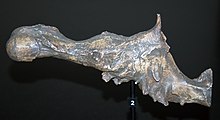
Somewhat unusually among theropods, T. rexhad a very long cochlea. The length of the cochlea is often related to hearing acuity, or at least the importance of hearing in behavior, implying that hearing was a particularly important sense to tyrannosaurs. Specifically, data suggests that T. rex heard best in the low-frequency range, and that low-frequency sounds were an important part of tyrannosaur behavior.[152] A 2017 study by Thomas Carr and colleagues found that the snout of tyrannosaurids was highly sensitive, based on a high number of small openings in the facial bones of the related Daspletosaurus that contained sensory neurons. The study speculated that tyrannosaurs might have used their sensitive snouts to measure the temperature of their nests and to gently pick up eggs and hatchlings, as seen in modern crocodylians.[52]
A study by Grant R. Hurlburt, Ryan C. Ridgely and Lawrence Witmer obtained estimates for Encephalization Quotients (EQs), based on reptiles and birds, as well as estimates for the ratio of cerebrum to brain mass. The study concluded that Tyrannosaurus had the relatively largest brain of all adult non-avian dinosaurs with the exception of certain small maniraptoriforms (Bambiraptor, Troodon and Ornithomimus). The study found that Tyrannosaurus's relative brain size was still within the range of modern reptiles, being at most 2 standard deviations above the mean of non-avian reptile EQs. The estimates for the ratio of cerebrum mass to brain mass would range from 47.5 to 49.53 percent. According to the study, this is more than the lowest estimates for extant birds (44.6 percent), but still close to the typical ratios of the smallest sexually mature alligators which range from 45.9–47.9 percent.[155] Other studies, such as those by Steve Brusatte, indicate the encephalization quotient of Tyrannosauruswas similar in range (2.0–2.4) to a chimpanzee(2.2–2.5), though this may be debatable as reptilian and mammalian encephalization quotients are not equivalent.[156]
Social behavior
Suggesting that Tyrannosaurus may have been pack hunters, Philip J. Currie compared T. rexto related species Tarbosaurus bataar and Albertosaurus sarcophagus, citing fossil evidence that may indicate pack behavior.[157]A find in South Dakota where three T. rexskeletons were in close proximity suggested a pack.[158][159] Because available prey such as Triceratops and Ankylosaurus had significant defenses, it may have been effective for T. rexto hunt in groups.[157]
Currie's pack-hunting hypothesis has been criticized for not having been peer-reviewed, but rather was discussed in a television interview and book called Dino Gangs.[160] The Currie theory for pack hunting by T. rex is based mainly by analogy to a different species, Tarbosaurus bataar, and that the supposed evidence for pack hunting in T. bataar itself had not yet been peer-reviewed. According to scientists assessing the Dino Gangs program, the evidence for pack hunting in Tarbosaurus and Albertosaurus is weak and based on skeletal remains for which alternate explanations may apply (such as drought or a flood forcing dinosaurs to die together in one place).[160] Fossilized trackways from the Upper Cretaceous Wapiti Formation of northeastern British Columbia, Canada, left by three tyrannosaurids traveling in the same direction, may also indicate packs.[161][162]
Evidence of intraspecific attack was found by Joseph Peterson and his colleagues in the juvenile Tyrannosaurus nicknamed Jane. Peterson and his team found that Jane's skull showed healed puncture wounds on the upper jaw and snout which they believe came from another juvenile Tyrannosaurus. Subsequent CT scans of Jane's skull would further confirm the team's hypothesis, showing that the puncture wounds came from a traumatic injury and that there was subsequent healing.[163] The team would also state that Jane's injuries were structurally different from the parasite-induced lesions found in Sue and that Jane's injuries were on her face whereas the parasite that infected Sue caused lesions to the lower jaw.[164]
Feeding strategies
Most paleontologists accept that Tyrannosaurus was both an active predatorand a scavenger like most large carnivores.[165] By far the largest carnivore in its environment, T. rex was most likely an apex predator, preying upon hadrosaurs, armored herbivores like ceratopsians and ankylosaurs, and possibly sauropods.[166] A study in 2012 by Karl Bates and Peter Falkingham found that Tyrannosaurus had the most powerful bite of any terrestrial animal that has ever lived, finding an adult Tyrannosaurus could have exerted 35,000 to 57,000 N (7,868 to 12,814 lbf) of force in the back teeth.[167][168][169] Even higher estimates were made by Mason B. Meers in 2003.[45] This allowed it to crush bones during repetitive biting and fully consume the carcasses of large dinosaurs.[21]Stephan Lautenschlager and colleagues calculated that Tyrannosaurus was capable of a maximum jaw gape of around 80 degrees, a necessary adaptation for a wide range of jaw angles to power the creature's strong bite.[170][171]
A debate exists, however, about whether Tyrannosaurus was primarily a predator or a pure scavenger; the debate was assessed in a 1917 study by Lambe which argued Tyrannosaurus was a pure scavenger because the Gorgosaurus teeth showed hardly any wear.[172] This argument may not be valid because theropods replaced their teeth quite rapidly. Ever since the first discovery of Tyrannosaurus most scientists have speculated that it was a predator; like modern large predators it would readily scavenge or steal another predator's kill if it had the opportunity.[173]
Paleontologist Jack Horner has been a major proponent of the view that Tyrannosaurus was not a predator at all but instead was exclusively a scavenger.[115][174][175] He has put forward arguments in the popular literature to support the pure scavenger hypothesis:
- Tyrannosaur arms are short when compared to other known predators. Horner argues that the arms were too short to make the necessary gripping force to hold on to prey.[175]
- Tyrannosaurs had large olfactory bulbs and olfactory nerves (relative to their brain size). These suggest a highly developed sense of smell which could sniff out carcasses over great distances, as modern vultures do. Research on the olfactory bulbs of dinosaurs has shown that Tyrannosaurushad the most highly developed sense of smell of 21 sampled dinosaurs.[154]
- Tyrannosaur teeth could crush bone, and therefore could extract as much food (bone marrow) as possible from carcass remnants, usually the least nutritious parts. Karen Chin and colleagues have found bone fragments in coprolites (fossilized feces) that they attribute to tyrannosaurs, but point out that a tyrannosaur's teeth were not well adapted to systematically chewing bone like hyenas do to extract marrow.[176]
- Since at least some of Tyrannosaurus's potential prey could move quickly, evidence that it walked instead of ran could indicate that it was a scavenger.[174] On the other hand, recent analyses suggest that Tyrannosaurus, while slower than large modern terrestrial predators, may well have been fast enough to prey on large hadrosaurs and ceratopsians.[138][24]
Other evidence suggests hunting behavior in Tyrannosaurus. The eye sockets of tyrannosaurs are positioned so that the eyes would point forward, giving them binocular vision slightly better than that of modern hawks. It is not obvious why natural selectionwould have favored this long-term trend if tyrannosaurs had been pure scavengers, which would not have needed the advanced depth perception that stereoscopic visionprovides.[42][43] In modern animals, binocular vision is found mainly in predators.
A 2021 study focused on the vision and hearing of the small theropod Shuvuuia, to which Tyrannosaurus was compared suggests that Tyrannosaurus was diurnal and would have hunted predominantly during daylight hours, a feature it shared with Dromaeosaurus, a third dinosaur compared to Shuvuuia in the study.[177][178]
A skeleton of the hadrosaurid Edmontosaurusannectens has been described from Montana with healed tyrannosaur-inflicted damage on its tail vertebrae. The fact that the damage seems to have healed suggests that the Edmontosaurus survived a tyrannosaur's attack on a living target, i.e. the tyrannosaur had attempted active predation.[179] Despite the consensus that the tail bites were caused by Tyrannosaurus, there has been some evidence to show that they might have been created by other factors. For example, a 2014 study suggested that the tail injuries might have been due to Edmontosaurus individuals stepping on each other,[180] while another study in 2020 backs up the hypothesis that biomechanical stress is the cause for the tail injuries.[181] There is also evidence for an aggressive interaction between a Triceratopsand a Tyrannosaurus in the form of partially healed tyrannosaur tooth marks on a Triceratops brow horn and squamosal (a bone of the neck frill); the bitten horn is also broken, with new bone growth after the break. It is not known what the exact nature of the interaction was, though: either animal could have been the aggressor.[182] Since the Triceratops wounds healed, it is most likely that the Triceratops survived the encounter and managed to overcome the Tyrannosaurus. In a battle against a bull Triceratops, the Triceratops would likely defend itself by inflicting fatal wounds to the Tyrannosaurususing its sharp horns.[183] Studies of Sue found a broken and healed fibula and tail vertebrae, scarred facial bones and a tooth from another Tyrannosaurus embedded in a neck vertebra, providing evidence for aggressive behavior.[184] Studies on hadrosaur vertebrae from the Hell Creek Formation that were punctured by the teeth of what appears to be a late-stage juvenile Tyrannosaurus indicate that despite lacking the bone-crushing adaptations of the adults, young individuals were still capable of using the same bone-puncturing feeding technique as their adult counterparts.[185]
Tyrannosaurus may have had infectious salivaused to kill its prey, as proposed by William Abler in 1992. Abler observed that the serrations (tiny protuberances) on the cutting edges of the teeth are closely spaced, enclosing little chambers. These chambers might have trapped pieces of carcass with bacteria, giving Tyrannosaurus a deadly, infectious bite much like the Komodo dragonwas thought to have.[186][187] Jack Horner and Don Lessem, in a 1993 popular book, questioned Abler's hypothesis, arguing that Tyrannosaurus's tooth serrations as more like cubes in shape than the serrations on a Komodo monitor's teeth, which are rounded.[115]:214–215
Tyrannosaurus, and most other theropods, probably primarily processed carcasses with lateral shakes of the head, like crocodilians. The head was not as maneuverable as the skulls of allosauroids, due to flat joints of the neck vertebrae.[188]
Cannibalism
Evidence also strongly suggests that tyrannosaurs were at least occasionally cannibalistic. Tyrannosaurus itself has strong evidence pointing towards it having been cannibalistic in at least a scavenging capacity based on tooth marks on the foot bones, humerus, and metatarsals of one specimen.[189] Fossils from the Fruitland Formation, Kirtland Formation (both Campanian in age) and the Maastichtian aged Ojo Alamo Formation suggest that cannibalism was present in various tyrannosaurid genera of the San Juan Basin. The evidence gathered from the specimens suggests opportunistic feeding behavior in tyrannosaurids that cannibalized members of their own species.[190] A study from Currie, Horner, Erickson and Longrich in 2010 has been put forward as evidence of cannibalism in the genus Tyrannosaurus.[189] They studied some Tyrannosaurus specimens with tooth marks in the bones, attributable to the same genus. The tooth marks were identified in the humerus, foot bones and metatarsals, and this was seen as evidence for opportunistic scavenging, rather than wounds caused by intraspecific combat. In a fight, they proposed it would be difficult to reach down to bite in the feet of a rival, making it more likely that the bitemarks were made in a carcass. As the bitemarks were made in body parts with relatively scantly amounts of flesh, it is suggested that the Tyrannosaurus was feeding on a cadaver in which the more fleshy parts already had been consumed. They were also open to the possibility that other tyrannosaurids practiced cannibalism.[189]
Pathology
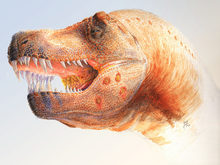
In 2001, Bruce Rothschild and others published a study examining evidence for stress fractures and tendon avulsions in theropoddinosaurs and the implications for their behavior. Since stress fractures are caused by repeated trauma rather than singular events they are more likely to be caused by regular behavior than other types of injuries. Of the 81 Tyrannosaurus foot bones examined in the study, one was found to have a stress fracture, while none of the 10 hand bones were found to have stress fractures. The researchers found tendon avulsions only among Tyrannosaurus and Allosaurus. An avulsion injury left a divot on the humerus of Sue the T. rex, apparently located at the origin of the deltoid or teres major muscles. The presence of avulsion injuries being limited to the forelimb and shoulder in both Tyrannosaurus and Allosaurus suggests that theropods may have had a musculature more complex than and functionally different from those of birds. The researchers concluded that Sue's tendon avulsion was probably obtained from struggling prey. The presence of stress fractures and tendon avulsions, in general, provides evidence for a "very active" predation-based diet rather than obligate scavenging.[191]
A 2009 study showed that smooth-edged holes in the skulls of several specimens might have been caused by Trichomonas-like parasites that commonly infect birds. Seriously infected individuals, including "Sue" and MOR 980 ("Peck's Rex"), might therefore have died from starvation after feeding became increasingly difficult. Previously, these holes had been explained by the bacterious bone infection Actinomycosis or by intraspecific attacks.[192]
One study of Tyrannosaurus specimens with tooth marks in the bones attributable to the same genus was presented as evidence of cannibalism.[189] Tooth marks in the humerus, foot bones and metatarsals, may indicate opportunistic scavenging, rather than wounds caused by combat with another T. rex.[189][193]Other tyrannosaurids may also have practiced cannibalism.[189]
Paleoecology
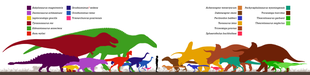
Tyrannosaurus lived during what is referred to as the Lancian faunal stage (Maastrichtianage) at the end of the Late Cretaceous. Tyrannosaurus ranged from Canada in the north to at least New Mexico in the south of Laramidia.[5] During this time Triceratops was the major herbivore in the northern portion of its range, while the titanosaurian sauropodAlamosaurus "dominated" its southern range. Tyrannosaurus remains have been discovered in different ecosystems, including inland and coastal subtropical, and semi-arid plains.
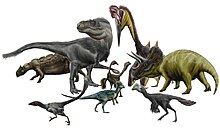
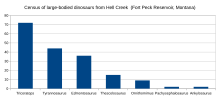
Several notable Tyrannosaurus remains have been found in the Hell Creek Formation. During the Maastrichtian this area was subtropical, with a warm and humid climate. The flora consisted mostly of angiosperms, but also included trees like dawn redwood (Metasequoia) and Araucaria. Tyrannosaurusshared this ecosystem with ceratopsiansLeptoceratops, Torosaurus, and Triceratops, the hadrosaurid Edmontosaurus annectens,the parksosaurid Thescelosaurus, the ankylosaurs Ankylosaurus and Denversaurus, the pachycephalosaurs Pachycephalosaurusand Sphaerotholus, and the theropods Ornithomimus, Struthiomimus, Acheroraptor, Dakotaraptor, Pectinodon and Anzu.[194]
Another formation with Tyrannosaurusremains is the Lance Formation of Wyoming. This has been interpreted as a bayouenvironment similar to today's Gulf Coast. The fauna was very similar to Hell Creek, but with Struthiomimus replacing its relative Ornithomimus. The small ceratopsian Leptoceratops also lived in the area.[195]
In its southern range Tyrannosaurus lived alongside the titanosaur Alamosaurus, the ceratopsians Torosaurus, Bravoceratops and Ojoceratops, hadrosaurs which consisted of a species of Edmontosaurus, Kritosaurus and a possible species of Gryposaurus, the nodosaur Glyptodontopelta, the oviraptorid Ojoraptosaurus, possible species of the theropods Troodon and Richardoestesia, and the pterosaur Quetzalcoatlus.[196] The region is thought to have been dominated by semi-arid inland plains, following the probable retreat of the Western Interior Seaway as global sea levels fell.[197]
Tyrannosaurus may have also inhabited Mexico's Lomas Coloradas formation in Sonora. Though skeletal evidence is lacking, six shed and broken teeth from the fossil bed have been thoroughly compared with other theropod genera and appear to be identical to those of Tyrannosaurus. If true, the evidence indicates the range of Tyrannosaurus was possibly more extensive than previously believed.[198] It is possible that tyrannosaurs were originally Asian species, migrating to North America before the end of the Cretaceous period.[199]
Population Estimates
According to studies published in 2021 by Charles Marshall et al., the total population of adult Tyrannosaurus at any given time was perhaps 20,000 individuals, with computer estimations also suggesting a total population no lower than 1,300 and no higher than 328,000. The authors themselves suggest that the estimate of 20,000 individuals is probably lower than what should be expected, especially when factoring in that disease pandemics could easily wipe out such a small population. Over the span of the genus' existence, it is estimated that there were about 127,000 generations and that this added up to a total of roughly 2.5 billion animals until their extinction. In the same paper, it is suggested that in a population of Tyrannosaurus adults numbering 20,000, the amount of individuals living in an area the size of California could be as high as 3,800 animals, while an area the size of Washington D.C. could support a population of only two adult Tyrannosaurus. The study does not take into account the amount of juvenile animals in the genus present in this population estimate due to their occupation of a different niche than the adults, and thus it is likely the total population was much higher when accounting for this factor. Simultaneously, studies of living carnivores suggest that some predator populations are higher in density than others of similar weight (such as jaguars and hyenas, which are similar in weight but have vastly differing population densities). Lastly, the study suggests that in most cases, only one in 80 million Tyrannosaurus would become fossilized, while the chances were likely as high as one in every 16,000 of an individual becoming fossilized in areas that had more dense populations.[200][201]
Cultural significance
Since it was first described in 1905, T. rex has become the most widely recognized dinosaur species in popular culture. It is the only dinosaur that is commonly known to the general public by its full scientific name (binomial name) and the scientific abbreviation T. rex has also come into wide usage.[48] Robert T. Bakker notes this in The Dinosaur Heresies and explains that, "a name like 'T. rex' is just irresistible
| This article uses material from the Wikipedia article Metasyntactic variable, which is released under the Creative Commons Attribution-ShareAlike 3.0 Unported License. |
.