Utahraptor (meaning "Utah's predator") is a genus of large dromaeosaurid dinosaur that lived in North America during the Early Cretaceous period. It was a heavy-built, ground-dwelling, bipedal carnivore. It contains a single species, Utahraptor ostrommaysi, which is the largest-known member of the family Dromaeosauridae.


Discovery and naming

The first specimens of Utahraptor were found in 1975 by Jim Jensen in the Dalton Wells Quarry in east-central Utah, near the town of Moab, but did not receive much attention. After a find of a large foot-claw by Carl Limone in October 1991, James Kirkland, Robert Gaston, and Donald Burge uncovered further remains of Utahraptor in 1991 in the Gaston Quarry in Grand County, Utah, within the Yellow Cat and Poison Strip members of the Cedar Mountain Formation.[1] The holotype, CEU 184v.86, is currently housed at the College of Eastern Utah Prehistoric Museum, although Brigham Young University, the depository of Jensen's finds, currently houses the largest collection of Utahraptorfossils.[citation needed]
The type species, Utahraptor ostrommaysi, was named by Kirkland, Gaston, and Burge in June 1993. The genus name Utahraptor is in reference to Utah, where the remains were found. The specific name, ostrommaysi, is in honour to John Ostrom for his investigations on Deinonychus and its bird relationships, and Chris Mays, who helped in the research of Utahraptor by founding Dinamation.[1] Earlier, it had been intended to name the species "U. spielbergi" after film director Steven Spielberg, in exchange for funding paleontological research, but no agreement could be reached on the amount of financial assistance.[2]
Thiago Vernaschi V. Costa and David Normand in 2019 criticized the use of the species name U. ostrommaysorum since it has no clear justification or explanation. Although this spelling has been largely used by other authors, the genus Utahraptor was originally coined with the type species U. ostrommaysiand given that the International Code of Zoological Nomenclature offers no provision for forming a genitive form from two persons with different names, Costa and Normand conclude that the original spelling ostrommaysi has to be regarded as an arbitrary combination of letters and not a correctly formed genitive form. Under this reasoning, ostrommaysorum has no valid use and the original spelling ostrommaysi does not need an emendation. Other alternative and also invalid spellings were used in scientific literature, such as ostromaysi, ostromaysorum, ostromayssorum, ostromayorum and ostrommaysori.[3]
Description

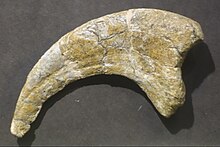
The holotype of Utahraptor, CEU 184v.86 consists of a second pedal ungual, with potentially assigned elements from other specimens: pedal ungual CEU 184v.294, tibiaCEU 184v.260 and premaxilla CEU 184v.400. These elements have huge proportions compared to other dromaeosaurids, suggesting an animal about twice the length of Deinonychus or, surpassing it in a 100%.[1] Like other dromaeosaurids, Utahraptor had large curved claws on their second toes. The second pedal ungual is preserved at 22 cm (8.7 in) in length and is estimated to reach 24 cm (9.4 in) restored.[1]
The largest described U. ostrommaysispecimen (BYUVP 15465, referred by Erickson et al. 2009[4]) is estimated to have reached up to 7 m (23 ft) long and somewhat less than 500 kg (1,100 lb) in weight, comparable to a polar bear in weight.[1] In 2012, the paleontologist Thomas R. Holtz Jr. estimated its weight around 230 to 450 kg (500 to 1,000 lb), comparable to a grizzly bear.[5]However, the 2001 Kirkland discovery indicates the species may be far heavier than previously estimated.[6] In 2016 Rubén Molina-Pérez and Asier Larramendi estimated the largest specimen (BYU 15465) at 4.65 m (15.3 ft) long, 1.5 m (4.9 ft) tall at the hips and 280 kg (620 lb) in weight; they claim the larger estimates are due to nine specimens of various ages being mixed.[7]

For instance, some elements were wrongly referred to the genus; the lacrimal bone of the specimen CEU 184v.83 turned out to be a postorbital from the ankylosaur Gastonia. Britt et al. also suggested that the previously identified manual unguals of the specimens CEU 184v.294, BYU 9438 and BYU 13068 are indeed pedal unguals.[8] This suggestion was confirmed by Senter in 2007.[9]

According to Kirkland et al. in 1993, Utahraptor can be recognised by the following autapomorphies: claws on the hand that are more specialized as cutting blades than in other dromaeosaurids; a lacrimal bone with distinctly parallel mesial and outer sides, giving it an elongate subrectangular appearance in top view; and a base of nasal opening on the premaxilla parallel to the premaxillary tooth row.[1] In the revised diagnosis conducted by Turner et al. in 2012, Utahraptor differs from other dromaeosaurids in: an elongate nasal process of the premaxilla; a distal end of metatarsalIII that is smooth, not ginglymoid; an L-shaped quadratojugal without a posterior process; the presence of a well developed notch between the lesser trochanter and greater trochanter; and dorsal vertebrae that lack pleurocoels.[10]
Although feathers have never been found in association with Utahraptor specimens, there is strong phylogenetic evidence suggesting that all dromaeosaurids possessed them. The genus Microraptor is one of the oldest-known dromaeosaurids, and is phylogenetically more primitive than Utahraptor.[11] Since Microraptor and other dromaeosaurids possessed feathers, it is reasonable to assume that this trait was present in all of Dromaeosauridae. Feathers were very unlikely to have evolved more than once, so assuming that any given dromaeosaurid, such as Utahraptor, lacked feathers would require positive evidence that they did not have them.[12] So far, there is nothing to suggest that feathers were lost in larger, more derived species of dromaeosaurs.[13] The presence of quill knobs in Dakotaraptor evidenced that even larger dromaeosaurids had feathers.[14]
Classification
Utahraptor is a member of the familyDromaeosauridae, a clade of theropoddinosaurs commonly known as "raptors". Utahraptor is the largest genus in the family, and belongs to the same clade of dinosaurs such as Velociraptor, Deinonychus or Dromaeosaurus. It is classified in the subfamily Dromaeosaurinae, which is found in the clade Eudromaeosauria.[1]
In 2015, Utahraptor was found to be closely related to the smaller Dromaeosaurus and the giant Mongolian and North American dromaeosaurid genera Achillobator and Dakotaraptor:[14]

The cladogram below is the result of a cladistic analysis conducted by Cau et al. in 2017.[15]
Paleobiology

Kirkland et al. noted that given the huge size of Utahraptor, it was not fast as Deinonychusand Velociraptor, instead, it would have had a similar speed to the contemporary iguanodonts, and being faster than fellow sauropods. Additionally, the thickness of the tibia indicates that the animal had a significant leg force in order to kill prey.[1]
It was also suggested that dromaeosaurids such as Velociraptor and Deinonychus, relied on their hand claws to handle prey and retain balance while kicking it, contrary to this, Utahraptor with a much greater weight, may have been able to deliver kicks without the risk of losing balance, freeing the hands and using them to dispatch prey.[1] According to paleontologist Gregory S. Paul, Utahraptorwas not particularly fast and would have been an ambush hunter that preyed on large dinosaurs such as the contemporary iguanodonts and therizinosaurs it shared its environment with. Its robust build and large sickle claw indicates it was well suited to hunting such prey. Like other dromaeosaurinedromaeosaurids, it may have also relied heavily on its jaws to dispatch prey—more so than other types of dromaeosaurids, such as velociraptorines.[16] In a 2001 study conducted by Bruce Rothschild and other paleontologists, two foot bones referred to Utahraptor were examined for signs of stress fracture, but none were found.[17]
Social behavior
In 2001, Kirkland et al, pursued a graduate student's discovery of a bone protruding from a 9-ton fossil block of sandstone in eastern Utah. It was determined to contain the bones of at least seven individuals, including an adult measuring about 4.8 m (16 ft), four juveniles and a hatchling about 1 m (3.3 ft) long. Also fossilized with the predators are the remains of at least one possible iguanodont herbivore. Kirkland speculated that the Utahraptor pack attempted to scavenge carrion or attack helpless prey mired in quicksand, and were themselves mired in the attempt to attack the herbivore. Similar sites such as the Cleveland-Lloyd Quarry and California's La Brea Tar Pitshouse such predator traps. Examination of the fossils are ongoing after a decade of excavation, but if Kirkland is correct, it may be one of the best preserved predator traps ever discovered. The fossils may further reveal aspects into the behavior of Utahraptor, such as whether it might have hunted in groups like Deinonychus was believed to have done. Whether all the Utahraptor individuals were mired simultaneously or were drawn in, one-by-one, is unclear.[6] Further examination of the block suggests that the number of Utahraptorremains may be double the amount previously assumed.[18]
While dinosaur behavior can only be theorized, it was later discovered in 2020 that Deinonychus may not have had complex social behavior seen in some pack-hunting animals alive in the modern era, based on differing dietary preferences in adults and juveniles indicating they did not live in long-term family groups. It is unknown if this lack of complex, cooperative social behavior also extended to Utahraptor.[19] However, the study ignored that there are many extant pack-hunting animals that do not live in permanent family units but in groups of unrelated individuals, such as Humboldt squid, humpback whalesand various predatory fish.
Paleoecology
Utahraptor lived in the lower part of the Cedar Mountain Formation, a bed known as the Yellow Cat Member. According to the authors of its description, Utahraptor had an important ecological role as a major carnivore of the paleofauna of the present-day Arches region during the Early Cretaceous, and could probably attack prey larger than itself. Group hunting of individuals of at least 3.5 m (11 ft) and 70 kg (150 lb), if proven, could have killed 8 m (26 ft) prey of a weight of 1 to 2 t (2,200 to 4,400 lb). Additionally, sauropods ranging between 20 m (66 ft) may have been an important part of its diet.[1] The paleontologist Thomas R. Holtzestimated that Utahraptor existed between 130 million and 125 million years ago.[5] In multiple occasions, the Yellow Cat Member has been dated to Barremian-Aptian ages. Sames and Schudack 2010 proposed a reassignment of the estimated age, compromising Berriasian to Valanginian stages, however, this interpretation wasn't followed by most authors.[20] Using advanced methods of radiometric and palynologicaldating, Joeckel et al. 2019 concluded that the Yellow Cat Member is indeed older that previous estimations. The deposition occurred between 139 ± 1.3 million to 134.6 ± 1.7 million years ago, or, Berriasian to Late Valanginianstages. Based on the presence of new palynoflora, Middle Berriasian–Early Hauterivian ages were provisionally assigned.[21]
Environmental flora
Utahraptor was unearthed from the Yellow Cat Member, which during the Berriasian to Late Valanginian was a semiarid area with floodplain prairies, riverine forests, and open woodlands predominated by conifers (Pinophyta), ferns (Polypodiopsida), hornworts (Anthocerotophyta) and other vascular plants.[21] During the description of Mierasaurus, it was interpreted that there was also a waterlogged bog-like environment.[22] There is believed to have been a short wet season. This is supported by the presence of charred spores and other carbonized plant debris in the pollen maceral that indicate the occurrence of ancient wildfires ignited during periods of low precipitation.[16][21]
Contemporaneous fauna

Paleofauna that were contemporaneous with the dromaeosaurid in the Upper Yellow Cat Member included numerous dinosaurs, such as the iguanodonts Iguanodon, Hippodracoand Cedrorestes, the other theropodsMartharaptor and Nedcolbertia, the nodosaurid Gastonia, and the sauropodsCedarosaurus and Moabosaurus.[22][23][24]The only known mammal from the Upper Yellow Cat Member is Cifelliodon.[25]
Other non-dinosaur taxa known from the Member include the fish Ceratodus and Semionotus, the turtles Glyptops and Trinitichelys, Aquatilavipes (fossilized bird tracks), the rhynchocephalianToxolophosaurus, and the indeterminate remains of hybodontid and polyacrodontidsharks.[23]
Additional paleofauna was recovered, most of it being unnamed and/or indeterminate, including an isolated Mesoeucrocodylianskull that measures 20 cm (7.9 in) in length.[23]A Neochoristodere unearthed from the Upper Yellow Cat Member, represented by a partial left femur,[26] shows that aquatic paleofauna was present and diverse during the Early Cretaceous of the Cedar Mountain Formation.[23] A large sail-backed iguanodontrepresented by large vertebrae and fragmentary remains.[27] An indeterminate eudromaeosaur known from a caudal vertebraand fragmented tail (UMNH VP 20209) was also present.[28]
Cultural significance
Raptor Red was published in 1995, and features the fictionalized story of a female Utahraptor. Written by paleontologist Robert T. Bakker, it was positively regarded by mainstream reviewers, though updates to the science have rendered some of the story line facts presented untrue and the paleontology community was critical of fossil record inaccuracies.[29][30] Bakker's anthropomorphosis of the titular Red was particularly praised.[31][32][33]
In 2018, it was proposed that Utahraptor be the Utah state dinosaur, an act that was approved by the Senate.[34] Initially Utahraptor would have replaced another dinosaur, Allosaurus, as the state's official fossil, but it was decided that Utahraptorwould be another symbol of the state.[35] In 2021, Steve Eliason.[36][37] sucesssfully created a proposal for Utahraptor State Parkwhere the block was discovered. It was approved by the state House.[38]
| This article uses material from the Wikipedia article Metasyntactic variable, which is released under the Creative Commons Attribution-ShareAlike 3.0 Unported License. |