Yamaceratops is a genus of primitive ceratopsian that lived in Asia during the Late Cretaceous period in what is now the Javkhlant Formation. Initially, the rocks it was found in were thought to be from the Early Cretaceous, but the age was reevaluated in 2009.[1]
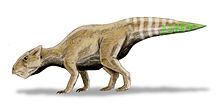
The type species, Yamaceratops dorngobiensis, was described by P. J. Makovicky and M. A. Norell in September, 2006. The authors consider the animal to have had an intermediate phylogenetic positionbetween Liaoceratops and Archaeoceratopswithin Neoceratopia. Examination of the frillof Yamaceratops has convinced the authors that the frill was not used for display, and that the fossils "[hint] at a more complex evolutionary history for ceratopsian frills."[2]
The genus name refers to Yama, a TibetanBuddhist deity; the species name to the Eastern Gobi. The holotype IGM 100/1315consists of a partial skull; other material has been found in 2002 and 2003 and has been ascribed to the genus.[2]
A fossilized embryo found within an ornithischian eggshell from sediments where Yamaceratops is common may belong to this genus.[3]
In 2020 Minyoung Son and colleagues reported a juvenile specimen of Yamaceratops found in 2014 at the Khugenslavkhant locality.[4]
| This article uses material from the Wikipedia article Metasyntactic variable, which is released under the Creative Commons Attribution-ShareAlike 3.0 Unported License. |